


This is Part II of a three-part mini series on Freedom. Last week we dipped our toes in the tide pool-turned-ocean that is the concept of Freedom. Today, we put on our wetsuit. Since we’ve got six different flavors of freedom, the split is simple: three scoops each. This essay covers financial, professional, and physical freedom. More poetically put, Freedom of Capital, Freedom of Work, and Freedom of the Body. In Part III we’ll do Freedom of the Heart, Freedom of the Spirit, and Freedom of the Mind. After that, I’ll need to take a little time off to finish the Very and Unexpectedly Large Research Report on the Impact of Generative AI on Creatives that I’ve been working on for many months. (Confession: I’ve grown a little bit infatuated with data visualizations)
Also, note! This series on freedom does not pretend to be some world-altering manifesto. The tech overlords do those. Nor do I pretend to have drunk from the Golden Vessel of Eternal Wisdom so that I may dispense it all here on these pages. For that I recommend the Indiana Jones movies. No no. These essays are an invitation to explore a little deeper the thing we tend to blindly celebrate in this country, this ephemeral thing that underpins democracy, and to throw open all the windows in the house that freedom built. As always, read with a critical mind—that is, after all, what The Dojo is for. If you find yourself in disagreement with a thought or line of reasoning, or feel that a particular angle or point of view is lacking, do share plentifully in the comments.
Lastly, forgive the non-fancy infographics :)
If this is your first time here at The Dojo, I strongly recommend to start with the welcome post, which gives you critical context for the entire series.
Freedom of capital
Financial freedom is one of the ultimate markers of success, as considered by modern industrialized societies. Ironically, in our pursuit of this type of freedom we end up tying our lives into multi-level Gordian knots, tangling up many of our other freedoms in this singular and often life-long ambition, and effectively corrupting the very definition and meaning of the term. We amass piles of loans to obtain college degrees, MBAs, and PhDs; we spend years clawing our way up the corporate ladder; we sign our lives away in 30-year mortgage contracts and plow our wages into stock investments, Roth IRAs, and 401(k) retirement accounts. All so we can claim title, status, assets—in other words, our society’s definitions of stability and success.
Note, there is no value judgment implied here. Financial stability is indeed a critical component of success, but it depends on how you define financial stability for yourself: what lifestyle and what kind of life experience do you desire, and how much money will that take? If you want that $5M home in New York or San Francisco, or perhaps an entire portfolio of properties around the world, your income/revenue generation journey will look drastically different from that of someone content with a modest house in the countryside. And if you’re in a real hurry to move into the mansion, you might need to downgrade some of your personal ethics and integrity. Does that make you free, or freer than others? It might, depending on your definition of freedom.
The rich tend to be simultaneously idolized and resented for their wealth, but in a certain respect they are no more free than the low-wage worker who can barely make ends meet. Note, “free” in this context doesn’t carry a dollar sign or a value assignment; we’re talking freedom in the foundational definition of the word. The “rich” person is restricted by his or her desire to maintain a certain lifestyle, while the “poor” person is restricted by the need to survive. Of course, the wealthy person does have the opportunity to opt for a simpler, slower life and leverage their wealth to fund it—should they choose to do so. The low-income person lacks this choice. True financial freedom means being able to sustain a baseline income over the long term that enables you to cover life’s basic needs, and to choose what to do with your money and how to live your life. It is not synonymous with wealth, power, and success.
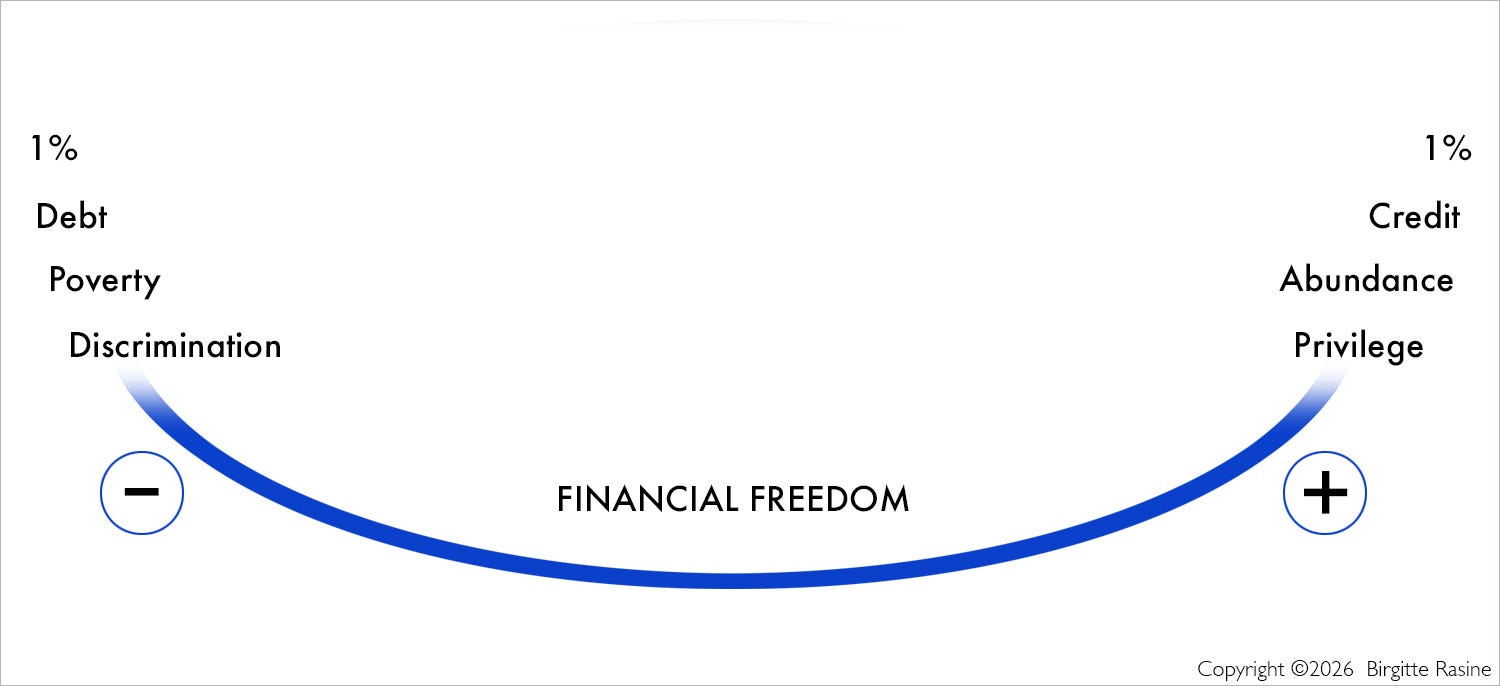
On the right side of the figure above, we see four concepts that embody the positive or beneficial aspects of financial freedom. On the left sit their polar opposites; and yes, the 1% on both sides of the spectrum is intentional. (Note, as we work through the various levels of freedom, the focal or reference point is always the individual human being—not society, family, nation, or any other grouping.)
Reaching the rarified company of the One Percenters is a fervent dream of many. Having fabulous wealth at your disposal is indeed freeing: you no longer have to work for wages or lift a finger of housework; you can buy virtually anything you want; you can go where you please, when you please; and multiple generations of your family are provided for. Yet unless you steel your mind and psyche against the Sirens of Fortune, you will likely fall prey to the tempting songs of extreme wealth and disconnect from many of the realities that govern the lives of the rest of your fellow humans. This is where the pendulum swings to the negative end of the spectrum: your wealth is at once freedom and imprisonment. If you’re a public figure in addition to being fantastically wealthy, you need a corps of body guards to protect your every move. You need to time your movements to avoid prying eyes. You build a complicated international tax structure to avoid unwanted taxes and preserve your billions. You have entire teams of people working for you across your portfolio of properties, and you need to trust ensure there is no weak link—and exercise no mercy when your people discover one. A certain amount of peer pressure keeps you on your toes as well—it just wouldn’t do to fly commercial with the unwashed masses, you know?
Being part of the One Percent is Privilege. But you don’t need to be a billionaire to benefit from privilege: having access to the right investment funds, getting insider knowledge, working with the top brokers, advisers, attorneys, and CPAs, even marrying into the right family—these are all forms of privilege that bring you financial freedom. On the other side of the spectrum sits Discrimination. It closes the same doors Privilege opens, and does so typically because you had the poor taste to be born the wrong color of skin, height, gender, nationality, ethnicity, faith, class, family, accent, or on the wrong side of the train tracks in town.
When we speak of Abundance vs Poverty, perhaps you imagine bank accounts flush with cash vs a tent pitched on an empty lot. Of the four pairs of elements in Figure 1, Abundance and Poverty are the most context-dependent. For what, truly, is Abundance? For some, it may be a 5-bedroom mansion in the Hollywood hills and a private plane sitting on the tarmac, while for others, it may be a small cottage in the mountains with a vegetable garden and a chicken coop. The mansion seekers might very well see the humble abode in the countryside as poverty-level living. Indeed, what we might consider poverty-level living here in the US often translates, dollar for dollar, into a decent life in a developing country. Defined in terms of personal freedom, Abundance and Poverty decouple from the decimal point and re-align with individual definitions of happiness. Financial freedom lies in the eyes of the beholden.
Finally, we have the tension between Credit and Debt, two constructs that have governed commerce and trade for at least 5,000 years and may predate writing itself. This is a fascinating history about which many books have been written; for our purposes here, suffice it to say that financial Debt generally signifies a lack of freedom, as opposed to Credit, which—assuming it’s properly managed—confers upon the individual the ability to operate within certain boundaries. Yet it’s not as black & white as one might think: as with Abundance and Poverty, the Credit-Debt duality depends on how one leverages it. High-net-worth individuals, for example, leverage their massive asset portfolios to take out loans (debt instruments) at interest rates that are lower than the rate at which their investments grow. Low-net-worth individuals, on the other hand, are often forced to pay usurious credit card rates or take out emergency loans, without the safety net of a few million in assets. In the former scenario, Debt turns into an instrument of financial freedom, while in the latter, it becomes a financial prison.
As long as you are tethered to your debt obligations, you are not financially free. Note what this means, and its attendant irony: a wealthy individual can have millions in loans taken out, with their massive assets as collateral, and pay more in just the annual interest than a low-income worker earns in a year, while the worker struggles to handle a loan of just a few thousand. It’s the low-income person who is shackled to their debt, not the billionaire. For the rich, debt is another tool to leverage wealth, while for the poor, it’s a prison.
It’s not the financial construct itself that defines an individual’s financial freedom; it’s the usage or experience of that construct, within the context of the individual’s specific situation, that defines it.
Freedom of Work
By “work,” I mean the work or activity to which you dedicate your life to, or a portion thereof. Here again we see the pairing of Privilege-Discrimination, although the context is no longer financial. Privilege in the workplace refers to the various benefits, opportunities, and support granted to you based on the same factors we discussed above, from physical personal traits and education to connections and culture. It means being promoted and mentored less because of merit and more thanks to pedigree, family, class, and other social factors. An obvious example you’ve surely heard before: depending on the field, a woman is more likely to receive fewer professional opportunities than her male counterpart over the course of her professional career. Her ideas and proposals may not be viewed with the same level of respect in meetings. In the case of gender specifically, this type of discrimination turns into glass ceilings, which we’ve heard far too much about. Same with job-related discrimination and lack of opportunities granted to people of color and other social minorities, people with disabilities, or to people of a certain age. Ironically, it is more difficult for those with privilege to see the privilege they carry, than for those who are denied the same benefits. Merit does come with a few strings attached, when you’ve been given the opportunity to earn that merit in the first place.
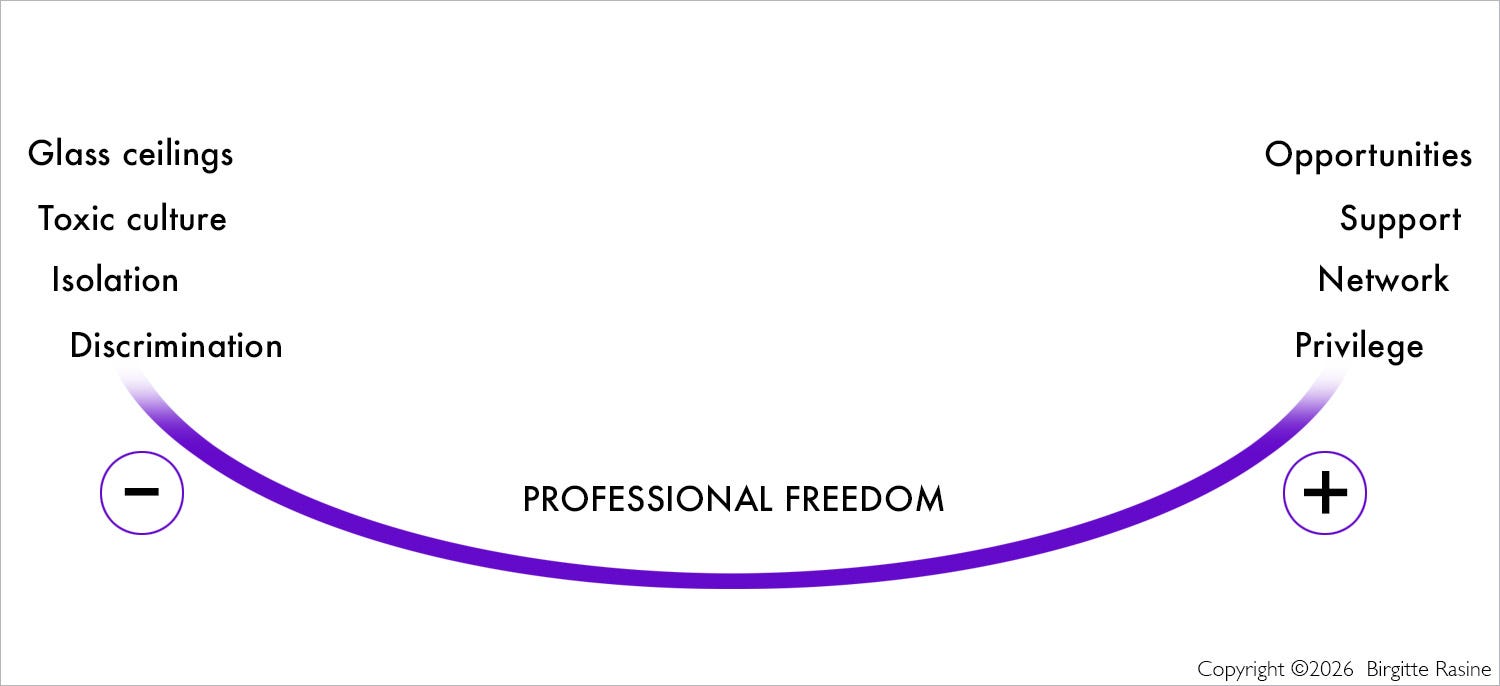
Your community of peers, the people in your network, also determine how much professional freedom you enjoy and leverage. These are your circles of support and protection—the closest you can get to a guarantee of a certain level of professional freedom. Even if you do not come from a place of privilege, a strong and nurturing network can open numerous doors, especially if you’ve got a natural instinct for charisma and conversation and actively maintain your relationships. Conversely, no matter how privileged you may be initially, if you isolate yourself or your ideas from your colleagues and peers, or you’re perceived as a non collaborator or a source of toxicity in the workplace, you may find yourself increasingly closed off.
When we look at the themes on the right of Figure 2, we can see they go hand in hand: an individual might start off with Privilege, whether by birth, education, socioeconomic status, gender, ethnicity, or other qualities, build their networks, and thus gain the support and opportunities that help make him or her successful. Or, a person might work hard at building a network or community which will then provide the support and opportunities that ultimately result in professional success and respect—in other words, privilege that is earned vs privilege that is gifted. Again, we’re not placing value judgments on these themes—they define their meaning in terms of the freedoms they either facilitate or restrict.
The concepts listed on the left side of Figure 2 may not be as closely interrelated to one another as a group, but they are the polar opposite of their counterparts on the right. Take, for example, Support vs Toxic Culture. A supportive work environment or professional network nurtures professional as well as personal growth, self-esteem, fulfillment, and development, all of which underpin freedom. A toxic environment, where you and/or your work is undervalued and where you are subject to harassment or discrimination, does the opposite, turning the workplace into a kind of psychological and mental prison.
Freedom in a professional context can be maddeningly complex and nuanced. Say you’ve worked in a particular sector all of your adult life, or simply have always been employed. You’ve always had that work family, community—your work village, as it were. One day, you get laid off. Your access to company systems is coldly cut off, you’re asked to pack up your personal belongings, and you’re out. It’s a shock, and it feels disorienting, disempowering, perhaps even devastating. Eventually, as you process the sentiments rolling through your mind and body, you realize you feel strangely free. No one is telling you where to go, what time to be there, what meetings to attend, when to take PTO, what deadlines to stay up late for. And yet, this is precisely the kind of freedom many people dread, because they’re used to structure. They’re used to someone setting their schedule and locking in deadlines. Having someone else make the key decisions is, in some ways, easier. Yes, and also freeing. So… which is it? Are you more free employed or unemployed?
It’s relative. It depends on what kind of person you are, whether you prefer stability and predictability and routine, whether you thrive on the raw freedom that working for yourself and being your own boss entails, or perhaps a blend of both. Regardless of sector or profession. These are preferences that might sway to and fro a bit throughout life, depending on other layers of context, such as your family situation (does your partner support you and/or do you have children or older parents to take care of), your level of financial freedom (as we just discussed), and whether or not your entrepreneurial ideas are able to take root in the marketplace (with the requisite material support that requires).
This is why generic declarations about “freedom,” professional or otherwise, don’t carry much substance without the context of one’s experience, preferences, or situation.
Freedom of the body
We now come to a more embodied form of freedom, and one that touches every one of us very personally—the freedom of your own physical body. This type of freedom blooms into a few different petals:
The legal freedom to move and travel—transporting your body physically from one place to another, be it within your city or to another country;
The freedom of health and mobility—being free from dealing with chronic disease or conditions, and having the physical ability to operate your body, e.g., walk, run, jump, sing, dance, swim, engage in sports, and so on;
The freedom of safety—living in a society or environment where you are (reasonably) protected from assault, rape, imprisonment, torture, or murder; and
The freedom of choice—being able to decide what happens to your own body. Perhaps no clearer and more striking example of this than a woman’s right to her reproductive freedoms.
If we turn the flower of bodily freedom 90º clockwise, it reveals another set of petals, related to the control we have over these freedoms:
What no one can control, i.e., force majeure: inherited conditions or genetic predisposition to disease; accidents and natural catastrophes; climate shifts and tipping points
What other people control: laws that regulate who can travel where or when, and what you are allowed to do with/to your body; costs of healthcare and medications; living wages to enable a healthy lifestyle; pollution of our soils, air, and waterways
What we can control but often ignore (assuming we have a stable financial situation): diet, exercise, sleep, and overall life choices
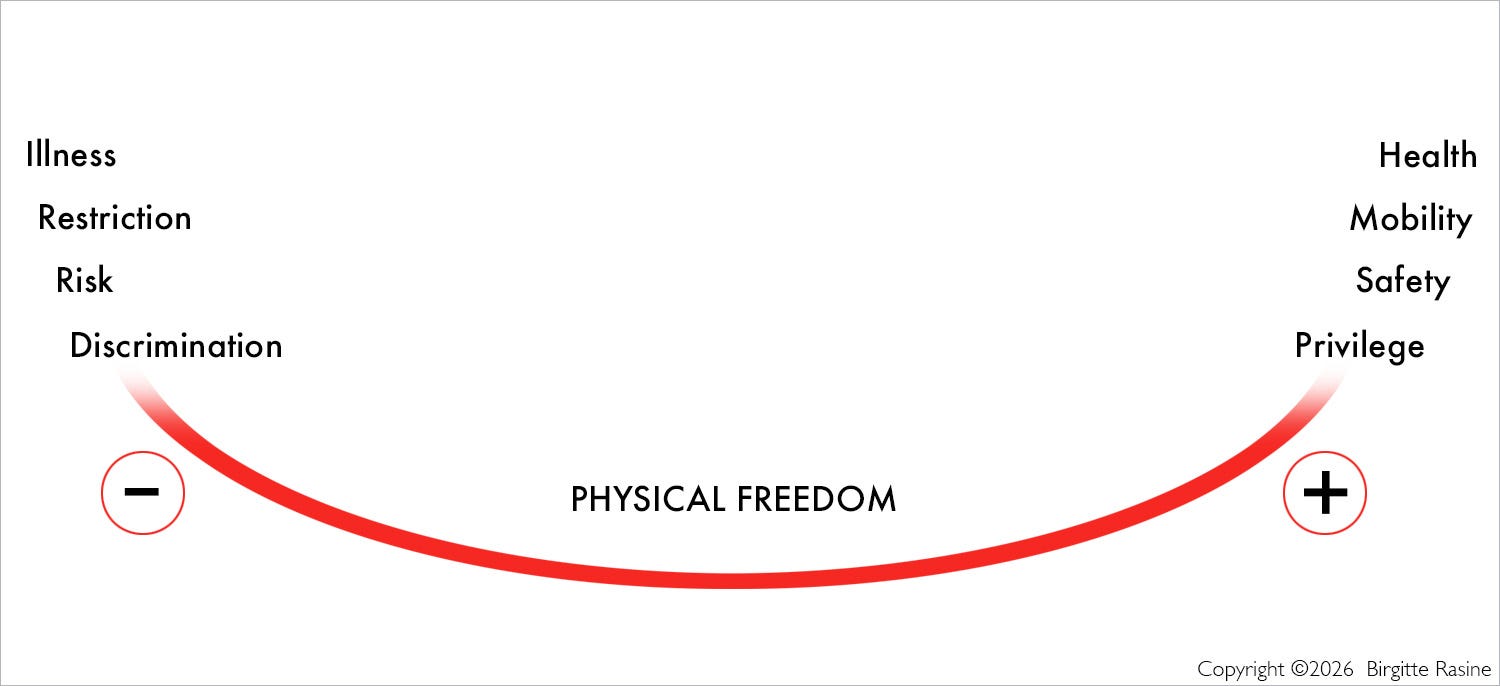
The freedoms of health, mobility, and choice are the most intimately close to us: they refer to the physical, tangible reality of our own bodies. For those of us who do not suffer from disability, chronic illness, or loss of limbs, we tend to take our bodies for granted. We don’t think about how it is that we move our fingers, hands, arms, toes, feet, legs, mouths, torsos… we just do. This does not reflect poorly on us as humans; we are simply following the law of inertia, on a psychological level. No need to expend daily emotional or mental energy on something we can reasonably rely on. So until we lose that neural connection from mind to muscle that gives us the freedom to move, we don’t truly comprehend or appreciate how extraordinary that mobility is. We do, however, routinely experience a loss of bodily freedom that’s a little less dramatic than paralysis or disability, and that is the (hopefully) occasional bout of the flu, norovirus, or other similar illness, that for most of us is temporary. As we lie sick in bed, the symptoms afflicting us in the moment, such as headache, stomach ache, cough, and general fatigue, make movement more difficult and cost more energy, relatively speaking, but we know we haven’t permanently lost our ability to move.
There is a deeper layer of freedom associated with general health. The freedom to move is one thing, but the freedom to exist in a healthy and functioning body is quite another. Again, if you’re generally in good health, it is likely you take your body for granted and assume it’ll function as needed for as long as you’re alive. How many of us have lunch at our desks so we can be more productive? How many of us eat far too much sugar and bad fats, don’t get enough sunlight, fresh air, sleep, and exercise, and pay zero attention to our posture? I can already see the raised hands. If you’ve ever had a serious illness or health condition, especially here in the United States where the costs of healthcare are so extraordinarily affordable for people of middle- and lower-income, you carry the lived experience of the enormous costs of managing and trying to cure that illness:
Money to cover all the bills
Time out of your day to travel to medical appointments
Time out of your life dealing with pain, discomfort, or disability
The psychological and mental energy to deal with the illness and all of its repercussions
The secondary impacts on your loved ones, friends, and potentially colleagues—and their time, money, and energy
On the opposite extreme of the health–illness and mobility–restriction spectrums are the world’s top athletes. Skiers, runners, mountaineers, gymnasts, swimmers, ice skaters, and others whose strength, stamina, and speed embody peak human achievement. Just as there is a gap between those of us who are physically disabled and/or chronically ill, and those of us who enjoy fairly stable levels of health and fitness, so there is an equally wide chasm between us regular people and the athletes. Who hasn’t marveled at the Olympians, the world champions, the record-breakers, and endeavored to imagine what that level of physical freedom must feel like: skiing down Mt. Everest, spinning four times in the air before landing, flying through the air on your skis, or freediving in the deep ocean unaided by scuba gear. Of course, these Olympic levels of physical freedom and ability aren’t “free” ... they’re earned, through hard work and long years of dedication.
These levels of freedom overlap and interplay every day: you can be perfectly fit and flexible (and free to move your body nearly any way you like) but stuck in a traffic jam on your way to work (not free to travel at the speed you’d like), or prevented from traveling to a specific country (if your visa is denied). You can be chronically ill (not free to move as you’d like, on a personal level) but safe in the neighborhood/town where you live (free to move about without fear for your safety or well-being). You can be permanently paralyzed (thus physically constrained) but because of the power of your mind and your scientific achievements, you’re invited to travel and speak all over the world (say, like the late Stephen Hawking). Some of the worst form of bodily imprisonment is being visited upon many of our fellow neighbors here in this country—in euphemistically labeled detention centers, where the rights to physical health, mobility, safety, and civil liberties are all crushed together in the blender of a cruel political ideology.
Above in Figure 3, we once again see the Privilege-Discrimination pairing; it is telling how pervasive this particular dynamic is in human society. In the context of the physicality of the body, Discrimination plays off race, ethnicity, gender, height, weight, hair color, sexual orientation, and other traits to restrict, oppress, and control an individual’s ability to exist and move in the world in the manner they choose. One of the most egregiously obvious examples of physical discrimination is racism, in the form of restricting a person’s movements based on their race or skin color, especially when the movement in question is the act of escape: fleeing war, violence, economic crises, or natural catastrophes. We need look no further than our own nation, where Latino, Middle Eastern, Asian and African immigrants are hunted down while White emigrés from South Africa are welcomed with the open arms of the highest political office. On the other side of the equation, Privilege worships the tall, the thin, the young, and the fit.
Closely related to the dynamic tension between Privilege and Discrimination is that of the Safety-Risk line. People of more “favorable” or typically preferred physical traits enjoy greater overall personal safety, while those usually discriminated against in a given population, namely minorities of culture, ethnicity, religion, and sexual orientation, naturally experience greater risk. This dynamic is also present in gender differences: a lone woman walking at night typically feels less physically safe than a man walking alone. Note, however, the equation changes when mitigating factors such as build, fitness, and training are introduced: a man in solid physical condition runs less of a personal safety risk than one who is out of shape and unable to run or fight; and a woman, even of small stature, who is well trained in self-defense, carries a greater degree of confidence in her physical freedom than an untrained man, even if he is taller and larger than she is.
Tying it together
My intent here is neither to prescribe nor dictate, neither instruct nor deconstruct. To truly learn something, gain a deeper insight, or reach a new understanding, you can certainly lean on the shoulders of others—we all do!—but you’ve got to do the last-mile work for yourself, because your life, your mind, and your world view are unique and differ from everyone else’s. I don’t believe in gurus who sell step-by-step magical formulas for success and happiness—the very term formula, along with its siblings template, and the more promising X steps to [desired outcome], belie the marketing campaign that they all are.
These lines of thought I’ve woven here might spark some new way of thinking, perceiving, or experiencing the three freedoms covered: your work and profession, your money and finances, and your physical, embodied self. Perhaps you’ve already traveled this path and formed similar views, and consider this essay a confirmation of your own analysis. Or perhaps you’ll vehemently disagree, and that too is eye-opening in its own way. Whatever the case may be, the canvas is blank and awaits your brushstroke.
Gratitude
Whether you’re a paying subscriber or have bought me a coffee or two, know that your support is deeply appreciated. These essays burn through a fair amount of glucose and oxygen.

[direct link here if the giphy thingie doesn’t work]