

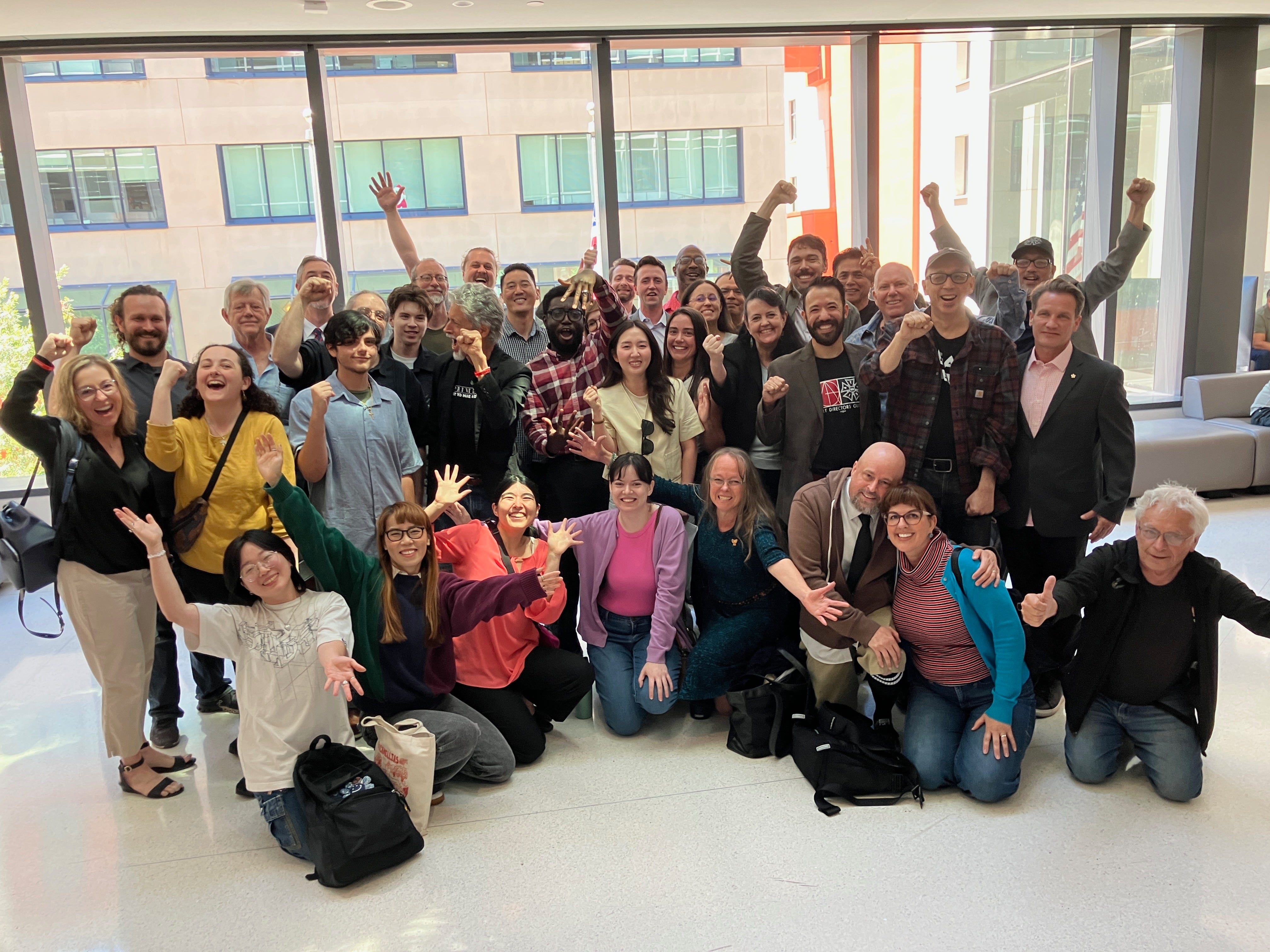
An illustrator. A storyboard artist. A concept artist working in games, VFX, and animation. Two high school students and a retired animator. More concept artists and illustrators. Photographers. Musicians. Voice actors and Oscar and Emmy announcers. Editors. Writers. Television producers. Audio engineers. Art directors and art instructors. People in leadership from NAVA, the Concept Art Association, SAG-AFTRA, the Art Directors Guild, IATSE Local 800, the Society of Illustrators, and the California Federation of Labor Unions. Professional creatives who’ve worked on the Star Wars and Avatar franchises, Lizzo’s It’s About Damn Time video, and the adidas short film/commercial that just played during the World Cup. People who’ve worked for Dreamworks, Electronic Arts, Riot Games, the big animation studios, major Hollywood studios, and indie game shops. From Fresno to Santa Cruz, from Napa to Los Angeles, California’s creatives stood shoulder to shoulder.
Young and seasoned, well-known and just starting out, we all stood in line, waiting for our turn at the microphone.
“I support AB 412.”
“I’m here [for] three of my kids who hope to be artists in the future.”
“I strongly support AB 412.”
“I am in full support.”
“We represent three thousand members with good union jobs, and we strongly support.”
“I’m here on behalf of my daughter and all of the young generations of creatives who really need a professional future.”
A little over a year ago, we stood up and got in the same line, for the same bill: AB 412, informally called the AI copyright transparency bill, which requires developers of generative AI models to document the sources of the data they use to train those models, and make that information available to registered copyright holders so the latter can make informed decisions about whether their intellectual property was used as training data. In December 2025, the legislators came to us, and we packed a conference hall at Stanford University. On June 8 of this year, we were back in Sacramento to support the bill as it was brought up to the California Senate Privacy, Digital Technology, and Consumer Protection Committee (it passed).
This past Tuesday, June 23, we attended the Senate Judiciary Committee hearing, the fifth hearing for AB 412. We packed the room and overflowed into the hallway. For two hours we sat and stood, in the room and outside in the corridor. It took two whole hours, but then again it took only two hours for our bill to be heard. It happened to be one of the busiest legislative days at the State Capitol—in the Senate Judiciary hearing alone, there were 55 bills listed on the day’s agenda. The legislators responsible for presenting their bills were running from one meeting to another, often from one physical building to another, causing the preset order on the agenda to be effectively thrown out the window. (AB 412 was assigned the lucky number 7 on the agenda. I briefly considered playing the Lotto with the numbers of the bills called out of order.)
There was a very real possibility we’d be there all day, as lunch recess was 12–1:30pm, and time was ticking. But we’d come this far, and we’d stay as long as it took.
Then, 30 minutes before the scheduled recess, we got the word. I was right behind Tim Friedlander, head of the National Association of Voice Actors (NAVA), as he called out to the artists gathered in the hallway, “We’re up! In a few minutes.”
It was game time.
Assemblymember Rebecca Bauer-Kahan, the primary author of AB 412, made opening remarks, followed by a statement from the supporting witness, Tim Friedlander, president of the National Association of Voice Actors (NAVA). In hearings like this, each side (supporting and opposing) has the right to bring in experts or interested parties to give remarks no longer than 2 minutes.
I’m posting Tim’s remarks here below (emphasis his):
“My name is Tim Friedlander. I’m a voice actor, songwriter, children’s book author, small business owner. I’m a SAG-AFTRA member, and the president and co-founder of the National Association of Voice Actors.
“AB 412 does not address the question of whether it’s moral, ethical, or even legal to train gen AI models on copyrighted materials. It simply offers rights holders the ability to inquire and to know whether their materials have or have not been used.
“Without transparency, we can only assume that our materials are in the data sets and take action accordingly. Creative jobs are real jobs and creative businesses are real businesses. We have as much right not to go bankrupt as any other business here in California.
“Recent data shows that creators account for seven and a half percent of California’s economy, with over one and a half million creators contributing more than 430 billion to our GDP. Copyright creates jobs; it drives greater and higher quality production, and it fuels cultural exchange. Every day without transparency, the value of copyright diminishes, and California risks losing its position in the marketplace as a cultural driver of the world.
“This bill is feasible and uses a very common and well understood approach the tech companies use regularly—an approach that even Google’s co-founder has written research papers about. In essence, AB 412 requires that a major industry be responsible for the provenance of the materials in its supply chain. That is not an unprecedented requirement in any other industry, and is not an unreasonable burden for this industry. California has the opportunity to lead in the adoption of fair, equitable, and balanced policy that does not prioritize one industry over all the others. I encourage an aye vote on AB 412. Thank you.”
If I had to choose 2 sentences to boil Tim’s remarks down to the core, I would say it’s these two: “AB 412 requires that a major industry be responsible for the provenance of the materials in its supply chain. That is not an unprecedented requirement in any other industry, and is not an unreasonable burden for this industry.”
Generative AI could not, and cannot, exist or function without the raw data extracted from the billions upon billions of words, image and video pixels, and audio produced by creatives. Our collective works have fed the Large Language Models that the AI companies are now monetizing and renting back out to us and to their enterprise customers. When you buy a bar of chocolate, you expect to see the ingredients listed. When you buy a car, you have a right to know where it was manufactured and where the parts come from. It should be the same for an industry that builds its products from the intellectual and physical labor of millions of creatives.


The opposition had two witnesses. The first one was Eric Butler from Sacramento, no affiliation given:
“I’m speaking in opposition to AB 412. I do believe that the goal is admirable. It is important to protect copyright. My only concern is with the feasibility of compliance with this bill… the way a lot of the data sets are generated, it may not be possible to track down every copyrighted work used in training. I do think that large companies can easily afford the expense to track down their training data and find out what was trained, but it might be harder or less feasible for smaller companies to do that, and that might shut them out of the market and hamper competition. Thank you. That is why I oppose. Thank you.”
Two points on this. First, consider the point of departure of the argument. Mr. Butler centers his argument on the creation of the data sets utilized by gen AI companies to train their models, rather than the creation of the works whose content is turned into the data sets. It is the work itself that should be the primary point of departure for any argument about copyright transparency, because without the work, there is no data, no data set, no generative AI model. The work, be it images, text, audio, video, or other content, is the source material. And this source material has embedded in it years of intellectual, emotional, psychological, financial, and physical labor and effort exerted by the creator of said work. Labor and effort that the creator has every right to draw a livelihood from.
Secondly, the statement “it may not be possible to track down every copyrighted work used in training” effectively incriminates the act of AI training—it implies that AI companies do, in fact, use copyrighted works in their training. The whole point of copyright is protection of authorship, and since the intention of AI companies is to monetize these models, as Mr. Butler himself alludes to at the end of his remarks, an AI company cannot claim “fair use.” Indeed, his concern that obliging AI companies to be transparent about the copyrighted works they’re using to train might “shut them out of the market and hamper competition” is rather disingenuous—what of the creators who produced the very works the AI companies are scraping without consent, credit or compensation? Are they not being shut out of the markets?
In short, Mr. Butler’s remarks ignore very completely the existence of the creators of the works ingested by gen AI companies.
The second speaker was Adam Eisgrau, Senior Director of AI, Creativity and Copyright Policy for an organization called Chamber of Progress. His remarks follow (all emphasis his):
“I’m Adam Eisgrau for Chamber of Progress. I respectfully urge a no vote on the bill. The concerns driving this bill are understandable. Creators want meaningful tools to protect their work and greater transparency regarding how AI systems are developed, but! AB 412 raises serious legal concerns.
“The bill is designed to help rights holders determine whether their works were used to train AI models and to pursue legal claims based on that information. Yet federal courts are still deciding the underlying legal question, whether AI training constitutes copyright infringement at all! Indeed, the only two federal court decisions to squarely address that central issue, both in the Northern District of California, have concluded the training can qualify as non-infringing legal fair use under federal copyright law. With more than a hundred such cases still pending, California should not, we respectfully submit, create a new state law regime that effectively assumes the answer before federal courts have established the governing rules.
“AB 412 also raises serious concerns under federal copyright pre-emption law. Copyright is exclusively governed by a national framework enacted by Congress and California, we again respectfully suggest, should be cautious about creating new state law obligations in this area. The bill’s sweeping mandate to find and disclose information to parties who may not even hold valid copyrights also raises substantial First Amendment compelled disclosure concerns.
“Setting the legal concerns aside, the emergence of new technological tools since AB 412 was introduced last March, make the bill increasingly unnecessary. Over the past year, creators have gained access to a growing set of market-based tools that already address many of the concerns motivating this bill. Website operators can block AI crawlers, artists can use tools, as you’ve heard in testimony, such as Nightshade and Glaze, to deter AI training, watermarking and content—”
Here the committee Chair, Senator Umberg, chimed in and asked Mr. Eisgrau to wrap up his remarks, as he had exceeded his allotted time. The latter did so, picking up from the last few words:
“… watermarking and content providence [he no doubt meant provenance] technologies allow creators to identify and protect their work. In sum, Sir—ten seconds—where practical solutions already exist, California should not adopt a legally uncertain framework, guaranteed to generate years of litigation.”
Before we get into the substance of these remarks, I’d like to note that text doesn’t do a message full justice; it’s missing the power and delivery of voice. Mr. Eisgrau would do well to join NAVA, as he leveraged his voice quite well to highlight several strategic points in his remarks, indicated in the bold italics above. Mr. Friedlander, being an actual professional voice actor, of course also utilized his voice. Both gentlemen spoke clearly and confidently. The difference in delivery was that Mr. Friedlander avoided overdramatizing his remarks, letting his words speak for themselves, while Mr. Eisgrau took the opposite approach, heavily emphasizing certain words, and using emphatic, strategic pauses in his remarks. It’s worth watching the recording (link below).
There is a lot packed into these 2.5 minutes of remarks.
First, Mr. Eisgrau makes the immediate claim that there are serious legal issues with AB 412, and quickly pulls federal law into the equation, ignoring the fact that this is a State bill, not a federal bill. Every state has a right to protect their economies and their workers, and that’s what our legislators are doing with AB 412, within the space allowed by federal copyright law. After his remarks, Assemblymember Bauer-Kahan clarified this point on federal pre-emption: “Federal [copyright] law does not cover transparency,” adding that no, California is not trying to write its own copyright law.
Eisgrau’s statement about the two courts that “concluded the [AI] training can qualify as non-infringing legal fair use under federal copyright law” takes these cases out of context, and brushes over the key word “can.” The word “can” implies potential and ability, not an absolute or permanent state. The fact that AI training can qualify as fair use implies that specific context is needed to determine whether or not said training does qualify, when and under what circumstances.
The statement “The bill’s sweeping mandate to find and disclose information to parties who may not even hold valid copyrights also raises substantial First Amendment compelled disclosure concerns” is misguided, as AB 412 pertains specifically to registered copyright holders, not creatives who have not registered their works. In addition, as Assemblymember Bauer-Kahan explained following the public comment period, an amendment to the bill stipulates that it is the registered copyright holder who must notify the AI company, rather than the AI companies proactively notifying any and all copyright holders; and the AI company then has 30 days to comply with the information request.
Mr. Eisgrau’s claims that “new technological tools” make AB 412 “increasingly unnecessary” and that “creators have gained access to a growing set of market-based tools” fall rather flat in the desert heat of present reality. AB 412 is focused on the concept of transparency, not on redefining copyright law. It doesn’t matter whether a fancy new tech tool helps a creator “identify and protect” their work—which, by the way, only places additional burdens on them: they must learn the tools, pay for them if they’re not free, ensure they have the right and sufficient hardware and software, and spend the time using the tools. (Heaven help the non technically minded creatives.) AI companies still need to be transparent about what copyrighted works they’re training on. Tech tools do not change this requirement, and they certainly don’t make it “unnecessary.” As for “website operators”—who are these people? Artists?—who supposedly can “block AI crawlers,” I regret to inform you, Mr. Eisgrau, that there is no honor among bots. Reports of web crawlers ignoring instructions not to train or scrape in robots.txt and other code, are plentiful, and publishers and other website owners are not thrilled.
Let’s let Edd Coates, the creator of the well-known Game UI Database, share his thoughts about his own experience with crawlers:
“I’m so sick of the Game UI Database getting scraped. Millions of requests per minute, designed to bypass all my security rules, completely choking the site until it stops working. If I were paying for bandwidth, it would cost me a fortune. How is this legal??
People conveniently forget the data theft that goes into powering LLMs, but THIS is the reality that so many website owners are experiencing right now. Massive amounts of information being taken by force. It’s incredibly frustrating, and honestly quite soul-destroying.
~ Edd Coates, on LinkedIn, June 2026
Edd’s post on LinkedIn sparked a lengthy thread, on which some engineers discussed a few possible ways to configure the back end to prevent the pesky web crawlers. When I DM’d Edd about those recommendations, he responded:
“The suggestions from the thread weren’t too useful sadly, as I already had Cloudflare in place and was monitoring the system as best I could. It’s not an *impossible* situation, but it is certainly an annoying one, since every attack means I essentially have to drop everything I’m doing to investigate the source of the scraping. This process can take a couple of hours, and is happening almost very few days at this point. It’s relentless.
“Scrapers are also getting harder and harder to detect as they’ll often spread out across multiple IP addresses, which not only means there’s no obvious ‘spike’ in the readings to let me know where the problem is coming from, but it totally bypasses many of Cloudflare’s security rules. So lately I’ve ended up just having to block/ban entire ASNs (Autonomous System Numbers) from my server, which can also potentially end up hurting many legitimate users.”
Coming back to our opposing witness: Mr. Eisgrau also ignores the fact that before all of these lawsuits, before AB 412 and any other similar legislation, AI companies knew from the start they were training on copyrighted works and went ahead anyway. A number of the founders, as we know, gave the green light fully aware there would be copyrighted work in their data sets (Midjourney’s founder admitted as much). No tech tools necessary then to “identify” works. They scraped without abandon. It is understandable why the AI companies and their various business and tech associations are so fiercely opposed to this bill: they simply want to take creatives’ work for free, with full legal impunity.
One last thing. I personally found Mr. Eisgrau’s final phrase rather striking: “…guaranteed to generate years of litigation.” There is nothing guaranteeing “years of litigation” in AB 412, unless, of course, his organization is planning on it.
We keep showing up
Why do we bother? It has been two years of hearings, with various bumps and hiccups along the way. For most of us, no one pays our travel, food, and accommodations. The answer however is clear: these are existential issues. Generative AI threatens much more than jobs and income, which is bad enough. It disintegrates professional dreams, undermines pathways of mentorship, and derails mastery of craft. Not to mention its now all too well-known water and energy requirements.
But perhaps the better question to ask is, why do our legislators in Sacramento bother? They could just ignore us completely and let Big AI do whatever it wants. If we all agree that the purpose and intention of a legal framework, in any society, is to protect its citizens, then AB 412 is a wonderful example of how a legislative body does just that. As Assemblymember Bauer-Kahan stated toward the end of her remarks, “[AB 412] allows us to give transparency to California’s artists, who … I want to thank for being here today, because I think the fact that they flew and showed up and took the day off work to be here, shows the importance of protecting our creative economy and the people who drive it every day.”
Professional lobbyists and representatives of groups and associations get paid to come to these meetings and oppose proposed legislation that might possibly run counter to their own special interests. All well and good, as long as there’s some semblance of equal time and equal resources (there usually isn’t). Of course some of the larger artists’ organizations were able to cover the travel expenses of their personnel. But for most of us creatives, no one paid the bill. If we flew, it was on our personal dime. If we drove, it was time away from work or looking for work. Parking fees, food, gas or EV charging, all paid for out of our own pockets. Still, we have shown up, every time, for every hearing, in strong numbers.
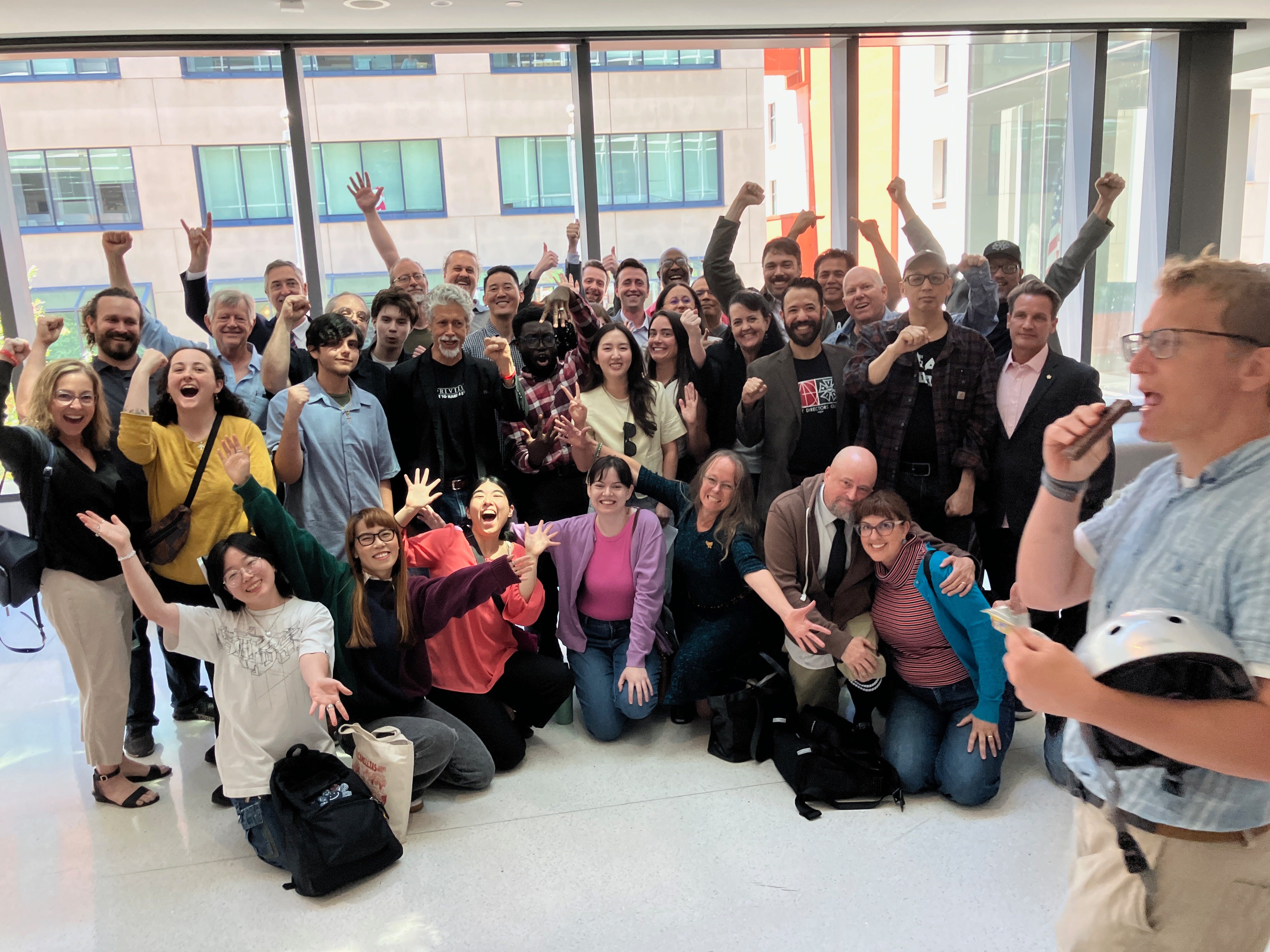
At the end of the day, as fervent as our sentiments about protecting our livelihoods are, we still know how to carry joy. We took photos after the session, one of which was inadvertently photobombed by… none other than one of the opposing speakers, Mr. Butler. He walked through the shot with a candy bar, and elicited some good-natured laughter from our group. No hard feelings. Although… as a chocolate judge, I might take him to task for choosing, apparently, a commercial candy bar instead of the good artisanal chocolate.
If you’d like to watch, the recording is here on the Senate Judiciary Committee’s website. The AB 412 segment starts at 01:59:53.
And if you found yourself as intrigued by the whole proceeding as I always am, please share with other like-minded friends and colleagues.
I need a coffee
Whether you’re a paying subscriber or have bought me a coffee or two, know that your support is always greatly appreciated. These essays burn through a fair amount of glucose and oxygen.

[direct link here if the giphy thingie doesn’t work]
Correction (June 26, 2026): The total number of bills on the agenda for the hearing was updated to 55, to reflect one additional bill that had been added after the paper agenda was already printed.
Thank you for writing and sharing this!
Congrats on the hard work of getting it considered. As a software developer working for a California publisher, I have some 'vested interest' in this topic.
The technical definitions are strong, but the bill sounds like Step 1 in a multi-step process? Seems like letting the rights-holders know is only part of the needed action. Or does it assume that the actual claiming can be done through regular copyright law?