

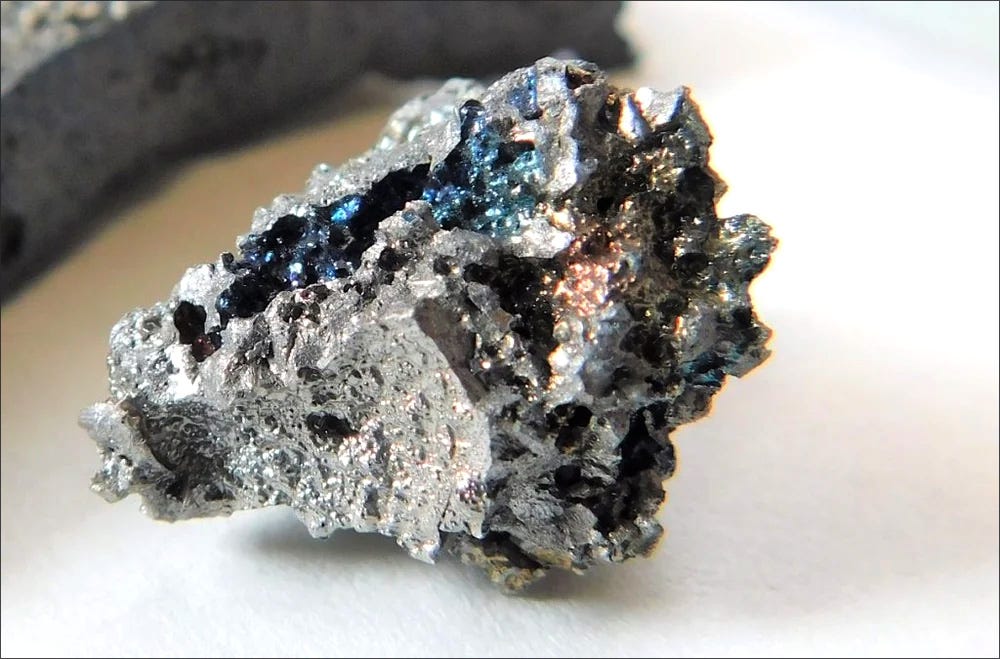
Welcome to The Dojo, a new space here at The Muse where we forge the tools and practices we need to develop and maintain a clear, resilient mind. Last week we opened the door and took a seat on the mat; today we take our first steps toward clarity: the purification of our mental space. The swordsmith cannot forge a powerful blade if the metal alloy has not been cleaned of its impurities; you might say mental clarity is similar to metal clarity.
If this is your first time here at The Dojo, please read the welcome post before you continue with this essay. The welcome post gives you critical context for the entire series. Besides, you’ll need to know what a tamahagane is.
The heat breathes through your every pore, expanding every cell, muscle, bone, vein. Eight minutes in, you’re glistening, natural oils coating your entire body. You think back to that summertime day in Madrid, so sticky hot all you could do is exist on the couch. This hits different—it’s a deeper, purer, healthier kind of hot. The wooden bench sweats with you, in silence. You dream of an ice-cold towel on your face. No, entire body, your mind insists. You breathe in the heat, slow, relaxed. You surrender completely. In two minutes you’ll be plunging into a cold tub, rejuvenated.
Saunas, for those medically able to do them, can work wonders for the body and mind. Their sustained, carefully maintained heat supports cardiovascular health, lowers blood pressure, reduces stress and depressive symptoms, improves breathing and lung function in general, and might even lower risk of dementia and Alzheimer’s (at least in Finnish men, so if you are one, onnittelut!). As those of you physically active in sports or exercise know, heat also eases joint pain, soothes muscle inflammation, aids muscle recovery, and improves range of motion (pro tip, don’t stretch your muscles before a run, martial arts training, or other exercise that requires a lot of energy and stamina, as they’re too cold to stretch; do at least a light jog to warm them up first).
Finally, the benefit we are most interested in here is the purification of the body: heat helps your body excrete toxins via the mechanism of sweat. Sweat does more than cool your body; it can remove toxic elements stored in your body fat, like drugs, medications, and heavy metals. Good news, too, for those of you without regular access to saunas—research suggests sweat resulting from exercise might be more effective for detoxification than the sweat you express in a sauna.
For our purposes, purification refers to the filtering out of unhealthy, weak, or harmful elements, be they habitual, emotional, psychological, or physical. This is the first step to a clear mind, the precursor to critical thinking.
Where dragons breathe
In many of the world’s cultures and traditions, purification requires fire.
As old as time, fire has traditionally been used to cleanse all that is unclean, unlucky, or unbalanced in the physical realm (the body), the psychological realm (emotions), and the spiritual realm (mind and psyche). We have innumerable examples of this in both ancient and living history:
The First Nations, or Native American people, use smudging, a practice of burning sacred herbs and “bathing” in the smoke to cleanse and purify body and mind.
The Celts used the smoke of ritual bonfires (like the Beltane) to purify and protect their homes, domestic animals, and themselves from harm, disease, and danger.
The Aborigines of Australia also perform smoke ceremonies, using their native plants, to purify themselves as well as their lands.
In Africa, the San, the Fãn, the Tem, the Maasai and other peoples utilize fire in their traditional rites for spiritual cleansing and rejuvenation.
In South Asia, Vedic and Hindu traditions hold fire rituals to offer blessing to the gods and rid communities of karmic impurities. Some Buddhist traditions also use fire to purify a person’s karma.
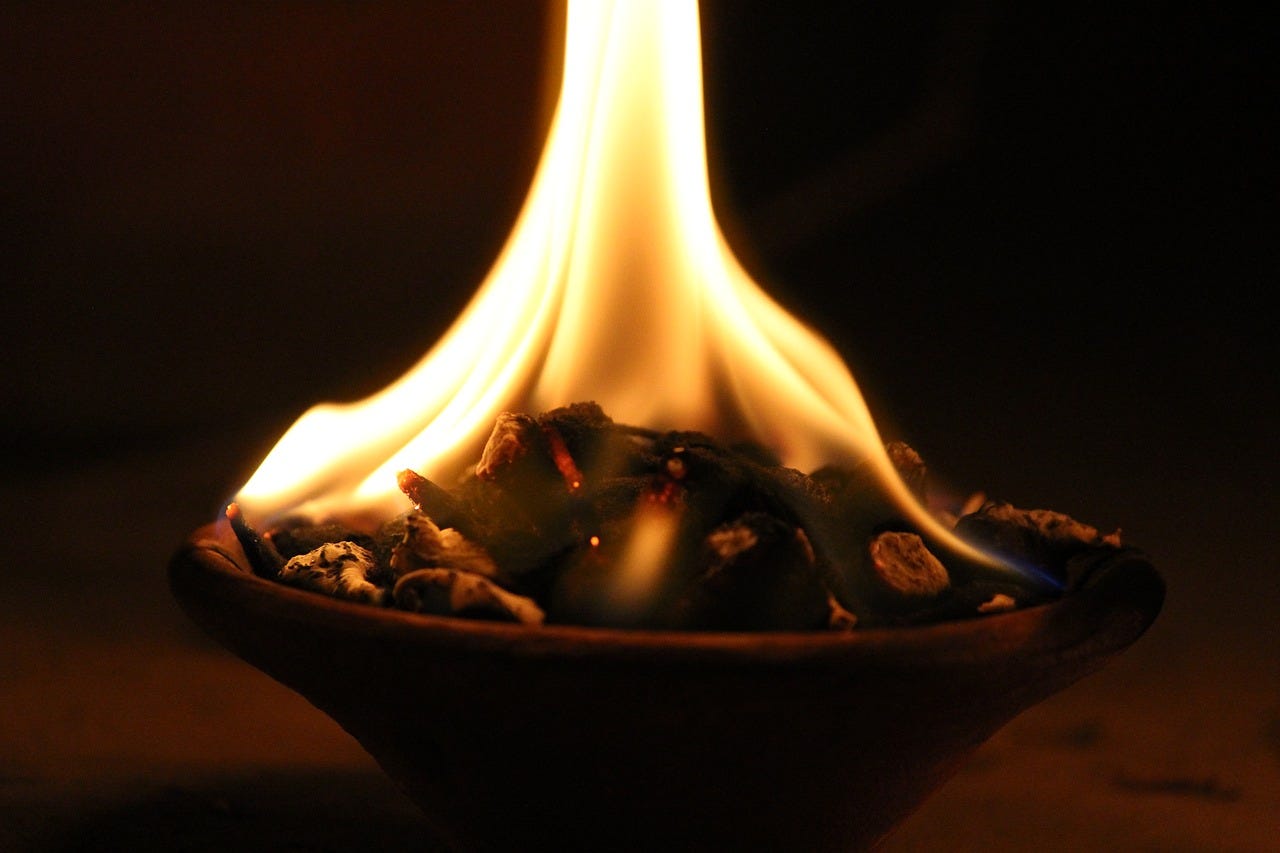
Fire rituals and ceremonies have been used for thousands of years to heal, cleanse, and purify individuals, families, and entire communities of corruption, sin, or negativity, and forge spiritual connections to the natural and divine forces governing the world. For the cultures that practice these rituals, fire is considered a life force. Modern science is a little less poetic. Some texts call fire an ionized gas, but that is technically incorrect. The ionized gas is the flame, not the fire. Fire itself isn’t gas and it’s not plasma; in fact, it isn’t matter at all. It is a chemical reaction we call combustion. What we conceive of as fire is the sensory experience of combustion, which requires fuel, oxygen, and heat. (By the way, did you know it’s gravity that gives flames their characteristic tapered shape? Fire in space is wild—it looks completely different.)
Fire’s capacity to purify relies on the intensity of its heat. This is what incinerates organic detritus or impurities, kills bacteria, viruses and pathogens (with the exception of those that are thermophilic), and separates precious metals from waste materials in foundries. Whether purification takes place through physical, chemical, symbolic or metaphorical processes, fire is a deeply transformative force honored and utilized by humanity since our very beginning.
Purification: ritual practice
During the Middle Ages, ancient Japanese swordsmiths performed two rites of purification: one for the spirit of the sword, and one for its body. For the sword’s spirit, they held a ceremony to gather benevolent spiritual entities to aid in the creation of a powerful sword, and for the sword’s body, they undertook a meticulous, disciplined months-long forging process. As for the spirit and steel of the sword, so for the mind and body of the warrior.
There is a certain beauty in honoring these profound, sacred traditions of craft, mastery, and excellence. We have lost much of the dedication, respect, and discipline it takes to achieve mastery of a craft, a profession, an art. We have grown soft, trained to expect the instantly gratifying, the free to use and consume, the prepackaged, the preposterous, the privileged. And still, it’s not enough for those who seek full dominion over us: our very capacity to think, to imagine, to create, is being undermined by an artificial algorithm masquerading as intelligence. Intertwined with this multi-layered loss comes the unraveling of our social cohesion, a corrosion of our economic systems, and a poisoning of our public communications spheres. Yet we have lost neither our awareness of the crucial significance of these things, nor our capacity to admire them and to desire to return to them. On the contrary: the more of our rights are torn from our civic bodies, the more viciously we are trampled and suppressed, the more financially, psychologically, and physically devastated, the stronger our pilot flame burns. Yes, that very same pilot flame that heats the tatara clay furnace where katana steel is forged.
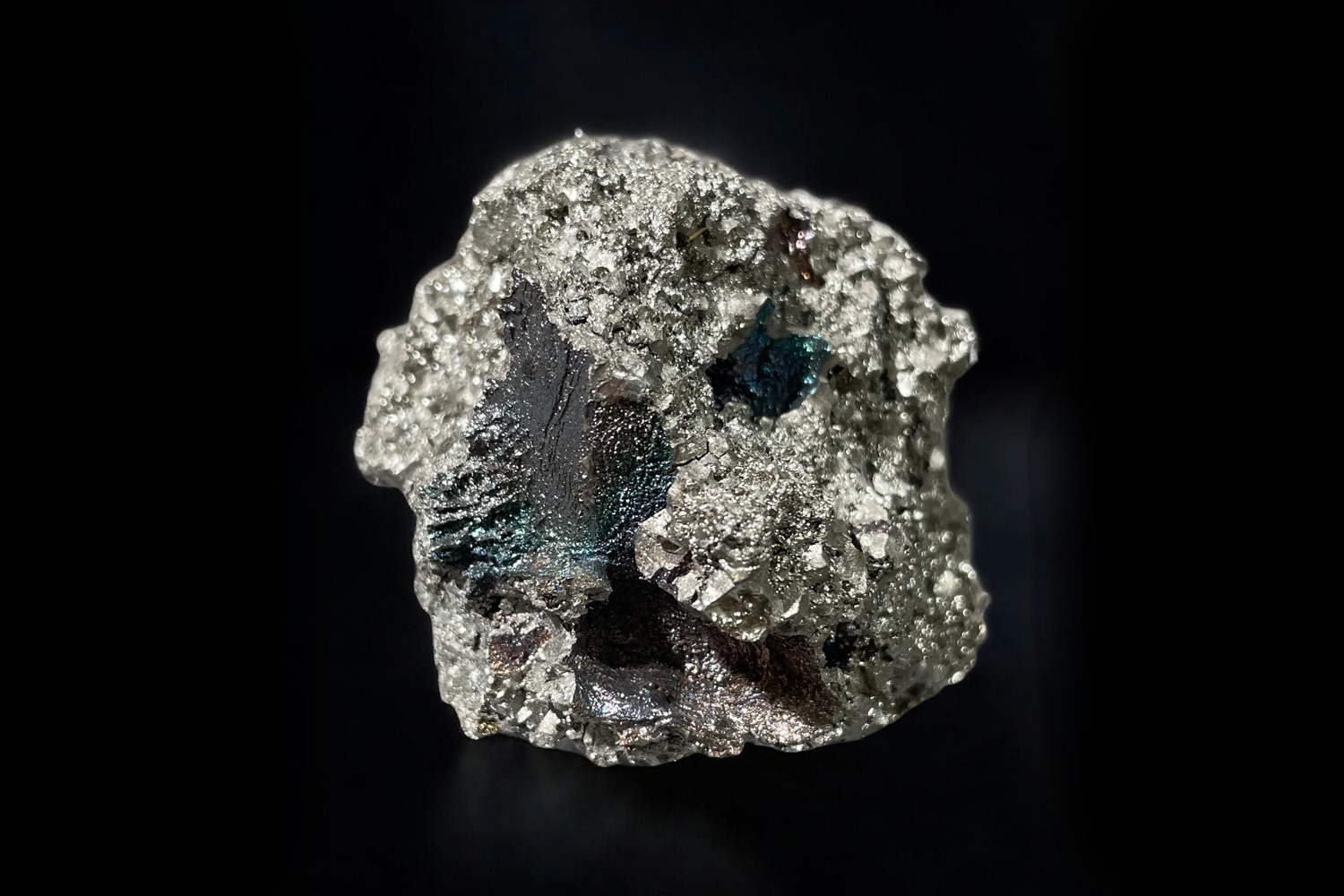
Before you can forge a katana sword, you need to filter out the impurities aggregated during the smelting process. The swordsmith selects the optimal sections of the tamahagane, the iron-carbon alloy billet we learned about previously, according to its carbon content. The selected pieces are heated again, hammered into thinner sheets, then carefully layered, reheated, and hammered again. The swordsmith selects the sheets of the highest quality for the specific type of sword construction he’s employing, folding the layers on top of each other until several hundreds and even thousands of layers of steel are created. Throughout this process, slag and other impurities are hammered and flattened out, resulting in a high-fidelity, low-impurity blade.
If you want a clear, sharp mind that cuts through fear, falsehood, and uncertainty the way a katana slices through bone, you need to smelt, and purify, your own personal tamahagane.
Impurities of the mind
Just as the master swordsmith takes the time to clean the steel of impurities before shaping it, so too we need to take the time to cleanse our mental space of impurities before we strive to shape or direct our thinking for a specific purpose or analysis, or even before we sit down for a few minutes of reflection or meditation. A Sisyphean task, if there ever were one today, in modern times. We have internal and external forces and interests pulling at our attention from the time we awaken to the time we fall asleep—and even during precious sleep, some companies have convinced us to plug our brains and bodies into their servers to track our sleep stats. So full of pieces and fragments and detritus of facts, events, experiences, emotions, sounds, images, words, and other “input” are our minds that we often do not even realize how much mental rubbish is sloshing around upstairs. No wonder the mind starts to wander the moment you sit down in your lotus position.
We should, however, first determine what constitutes an impurity of the mind. Is it, as perhaps some would be quick to suggest, a lascivious thought or sentiment? The nature and purpose of such thoughts depends on who they’re directed to or motivated by. Is it a consenting, willing partner, or an unwilling or perhaps even unaware one? Or is an “impure” thought one that focuses on unbridled greed, envy, hate, aggression, intolerance, fear? Not quite so simple to assign labels, without context. Emotions we habitually interpret as negative also have their context and purpose, at specific moments and situations. Could it be a friend’s or colleague’s seemingly innocuous chatter, small talk, gossip, that threatens to color your opinion of someone or something? What of comments and posts on social media, news headlines, Slack spaces and other communities? They’re all playing quantum ping-pong in your brain.
When are these stimuli relevant to life or work and when do they become impurities to be purged by fire? Where do we draw the trembling line between our own true thoughts and those that have been stuffed into our minds by the outside world? And what do we do when those “true ” thoughts are just as impure and detrimental to ourselves as anything external we encounter?
Imagine, for example, you are preparing a financial report that might incriminate your company’s CEO who has engaged in unethical or illegal activity, and your boss asks you to omit certain data to protect the CEO. In doing so, he introduces an impurity into your mental process, and that impurity could eventually imperil your position at the company as well. If, however, the CEO has conducted herself by the book, and the data your boss asks to be omitted is in fact erroneous data that had been introduced accidentally by a new team member, that same request no longer represents an impurity. In this scenario, the impurity is neither the request itself nor the data in question, but rather the potential for a deleterious outcome, a corruption of the intended result of your report preparation. If we compare the report to a katana, the impurities become clear.
(If you’re starting to think forging katana swords is a much simpler task than writing financial reports or navigating corporate politics, you would not be wrong.)
Here, in our dojo, there is no moral assignation to the term “impurity.” It refers neither to matters of sex, religion, or criminal behavior of any kind. The definition we’re using here is the simplest, most basic: “mixed with foreign matter; adulterated.” The swordsmith does not concern himself with the nature of the impurities in his tamahagane steel; he is simply focused on producing the strongest, sharpest, most durable katana. Anything that would compromise the desired qualities of his sword must be eliminated. The ancient swordsmiths did not worry that their katana swords would be used in an unethical manner, for the Samurai followed a strict code of honor and ethics, Bushidō—the “way of the warrior.” Just as the swordsmiths purged the swords of impurities, so too the Samurai purged their character and behavior of impurities.
Identifying and dissolving our mental impurities is a critical skill and habit, because they pop up everywhere, all the time, incessant, unavoidable, irreverent. They don’t care if you’re camera-ready or four days on without a shower, and they do not wait for your meditation appointment. They are the mosquitoes of your consciousness: tiny, ever mobile, annoying as hell, tough to kill, and potential carriers of deadly dis-ease. And of course there are swarms of them. Deep bow of apology to the katana swordmaker—the metaphor of tamahagane still very much holds, but the mosquito swarm is just too à propos here. Perhaps we can coax the swarm to fly right into the tatara furnace, for its ferocious fire will make short work of any winged impunity—er, impurity.
So. Where do we find the kind of fire that will incinerate those mud-caked shreds of thought, emotions, observations, points of view, and other experiences of the mind and psyche causing us to think or act irrationally, make unreasoned decisions, overreact and overdramatize, or simply conduct ourselves in ways damaging to us, our loved ones, and our communities?
Making your tamahagane
The fire is everywhere, but only you can stoke it and keep it alive. And just as impurities can pile up in a clay furnace with each shovel-ful of iron sands and charcoal, so too your mental space can grow too full of various impurities accumulated over a lifetime. There is a curious irony in the crosswise truths of a life long lived: the longer you live, the more wisdom and experience you gather, yet also the more trauma and toxic thought patterns. Awareness and conscious focus can help direct the flow of our vital energy where we want it to go, and minimize the impact of the impurities in our mind and psyche.
The pilot flame I mentioned earlier, burns in every single one of us. Some flames burn a little brighter, a little stronger, and some a little less, but we all have one. This is what sparks our life energy, our will to live. Ancient cultures have given this life energy different names throughout the centuries, that we still see in use today: ki, chi, prana, kundalini, koyopa. Some modern researchers believe this life force has a scientific basis, that is, it’s electromagnetic, which is fascinating on a whole other level (and that is another rabbit hole I shall resist).
Yes, the fire is everywhere, in so many forms. These are the three primary forms of purifying fire most easily available to you. Please chime in with your own thoughts in the comments! This is, after all, a dojo, where you get to speak too.
• Body heat sourced externally, such as that produced by a sauna or a hot shower, relaxes your body, and by extension, your mind. It’s much easier to relax and deep-breathe when your teeth aren’t chattering. You can make it a little personal fire ritual—any time you’re in the shower, forget about the outside world. Don’t think about work, the people you know, upcoming trips, your to-do list, not even the Substack essay you said you were going to write. Give yourself over to the water, completely.1 Let the heat cleanse your body and mind.
I recommend the shower over the sauna for a few practical reasons: a) you’re much more likely to have access to a shower in your home or while traveling; b) a shower is virtually free (technically, it’s included in your water and electricity bill); and c) a shower is—typically 😅—for you and you alone, whereas a sauna is a communal experience. One other reason, my personal favorite: taking a nice hot or very warm shower just before bed not only keeps your sheets cleaner, it deeply relaxes you, melts away stress and other mental impurities, and gives you a much better night of sleep. Why in the world would you force yourself awake at 5am to meditate when you can melt away into some of the deepest sleep with a spa for the mind?
• Body heat sourced internally, such as that generated by physical exercise. Running, skating, skiing, kickboxing, dancing, swimming—whatever you prefer, whatever you enjoy. I realize many of us don’t truly enjoy exercise, but I wonder if that’s because we actually don’t like to move (doubt that) or because we’re not “good” at whatever the sport or activity is. You don’t have to be good at it, you just have to be consistent with it. When I started running, I’d get a stitch in my side after just 20 minutes. When I started swimming, I lasted only a few laps each time. When I started martial arts, I was unfocused. And learning to ski after 40? Don’t even ask. But I persevered, and even though I won’t be joining the Olympic teams this year (or ever), I enjoy each one of these activities immensely. Each one is a different type of cleanse for my mind, body, and soul.
So keep at it, and put the full force of your will into it. Focus on the movement, the flow, yes the pain too. Push yourself a little: do as much as you can and then a few minutes more. This forces whatever mental and psychological impurities you’re carrying around, to get squeezed through your neural networks and evaporated along with your sweat. Do this on a regular basis, and you’ll see the profound benefits physical exercise delivers, especially for clarity of mind.
• Finally, the psyche’s inner fire. We are bioelectric beings. The heart’s pulses are regulated by a bioelectrical conduction system. Neurons exchange information with electrical signals. Our cells work with chemical as well as electrical signals, and according to some researchers, the electrical signals are more efficient at regulating cell function. Our senses, from hearing to taste to touch, utilize and/or generate bioelectrical signals. So, why not create a little metaphorical inner lightning and laser-focus our will on clearing our mental space of all the clutter?
This requires a lot more discipline and determination than hot showers and regular exercise. All that physical stuff is easy compared to mental work, precisely because you are always in your own head, mental work is interconnected with psychological work, and you cannot avoid or ignore the noise and clutter coming at you from all directions and dimensions. Even if you threw all your electronic devices out the window, disconnected your phone, and didn’t leave your house for a week, you would still think thoughts that are silly, weird, useless, even potentially detrimental to your own health and happiness (alongside all the good, healthy, productive thoughts, of course). That’s what makes each of us human, after all—we are constantly processing our inner as well as our outer worlds.
Again, no judgment here. It is not for me, or anyone else, to tell you what thoughts to think or the right emotions to feel. Only you can determine what lines of thought and emotional patterns serve you best. The one thing I will say, and urge you to hold very close to your heart, is that especially at the beginning of this mind/psyche purification process, you might not know which thoughts and which emotions are the rubbish ones. You might have to explore for a bit before you start seeing patterns in your thoughts and thought processes. Patterns you can recognize, and determine what is helping or hindering them. This is directly related to your level of self-awareness, but also the stage of life where you are, keystone things like your relationships, your career, and your ultimate life horizon.
Remember the scenario of the financial report and the boss’s request we ran through earlier. The impurity presented in that scenario wasn’t the data or the request itself, but the potential for a deleterious outcome (whether bad for you, for the report, for your boss, and/or for the CEO). We are used to labeling things, so the natural tendency is to label the thing (data) or the event (the request) as “the impurity” we must get rid of or block somehow. What we need to get used to is a different mental construct: the ability to understand or intuit the potential impact/s of “the thing you think is the impurity,” for only then can we determine whether it’s cluttering our mental space with the wrong intentions, insights, or strategies. Sometimes these impurities can be fairly innocuous, but they can also be quite toxic.
For me, what has worked is stone-cold, tireless discipline. The same kind of discipline practiced by our katana swordsmith hammering the hunk of tamahagane. A hundred blows, a thousand if need be. Whatever it takes to hammer out all the impurities, and turn the tamahagane into steel of the finest quality. Every headline you read, every social media post you come across, every email or comment from a friend or loved one, is an opportunity to test your impurity detection skills. Even the absence of communication is a signal.
And just so we don’t end on a vague motivational note, let me highlight an example too many of us can relate to: ghosting. Specifically, ghosting in the marketplace. Say you apply to a job. In fact, you apply to a hundred jobs. Just ten companies out of those hundred bother to respond; only three invite you to interviews; and of those three, two are with AI avatars (yes, sadly, it’s a thing). The other companies ghost you completely. The psychological effect this has on you as a jobseeker is of course, generally harmful. It’s depressing when an organization can’t even be bothered to respond. Sure, you know “it’s not you, it’s them.” That doesn’t help how it makes you feel, about yourself as a candidate, and as a person worthy of a fulfilling career and role in society.
So in this scenario, what is the mental/emotional impurity that’s corroding your mental clarity: the act of ghosting or having to talk to an AI avatar during your interview? Or maybe it’s a next-level impurity, e.g., your having agreed to an AI interview instead of standing by your principles and refusing to participate.
Answer: identifying the impurity here depends on your personal goal. Do you want this specific job, or any job in this particular sector? Or are you only going through the motions of applying for jobs when you would rather start your own business but are secretly scared of taking that step? In other words, before you go zapping these job-related “impure” emotions and thoughts in your heart and mind, address the 800-pound slag in your mental space first: the conviction that you need a corporate job instead of starting the business you’ve been thinking about. Who put that impurity there? Once you’re clear on the long-term horizon, all the smaller impurities and psychic toxins literally evaporate, because you won’t be bothered with applications any longer. You’ll have a different set of headaches of course, but they’re ones you choose to work through.
Closing bow
Crikey. Fully intended to keep this essay at around 2k words, but the writer’s pen seems heavier than the sword… Blame it on those excessively warm nighttime showers. I hope this exploration of the mental and psychic impurities that can cloud our daily experience of life has been useful. Please do share your own thoughts, experiences, and questions in the comments so we can continue exploring and learning together.
In the next post, we’ll spend some quality time with the concept of meditation and forging that inner calm that builds lasting mental clarity.
See you then!
Gratitude, always
Sincere thanks to everyone who has supported my work, and warmest of welcomes to all the new readers! Whether you’re a paying subscriber or have bought me a coffee or two, know that your support is felt and appreciated.

[direct link here if the giphy thingie doesn’t work]
Let go of anything you can’t bring into the shower with you. Once I tried playing music on my phone, outside the shower, just to see if I could hear it, but the roar of the water drowned it all out even when I tapped the volume all the way to the max. And yes I know about those fancy speakers you can have installed in the shower, but it has to be either or. Either you’re listening to music or you’re listening to water rushing over your body. Choose.