


Welcome to The Dojo, a dedicated space here at The Muse where we forge the tools and practices we need to develop and maintain a clear, resilient mind. Following the introductory welcome, we learned how to purify our mental space. Today, we clear our mind and psyche to allow learning and practice to flow unimpeded by desire, fear, or emotions or thoughts of any kind. This is the way of the warrior.
If this is your first time here at The Dojo, please read the welcome post before you read this one. The welcome post gives you critical context for the entire series.
His eyes drill into you, unblinking, sweat coating his face, his sprung energy ready to crush you. You don’t know how well trained he is, and wonder if you’re trained well enough for him. You hesitate, just a split second. That’s enough to give him the advantage, the first move. A tight-fisted ball of his will lands on your jaw, and your entire head ricochets. Muscle memory explodes: your leg whips a well-practiced roundhouse into a place he didn’t think to guard. You don’t wait—bring the leg back, touch the ground to reload, kick again, same spot because he’s still in disbelief a girl like you would strike with that kind of ferocity.
And you move, laterally. Diagonally. Backward, forward. Can’t stay in one spot. Adrenalin crackling, but you breathe, you remember you have to breathe. Low jab to the stomach, instant lateral move, evade his strikes. Move in, make a hit, get hit in turn, move back. Stay calm, downregulate, don’t let the panic rush in. Long, deep breaths driving one long fluid stack of strikes, the way they taught you.
Time! Round’s over. Next partner…
This is training, not a real street fight. A real fight, out on the streets, doesn’t have safety gear, padded mats, or an instructor calling time. It might be you against one, you against many, or against someone under the influence, immune to pain. But without training, you’ve got a non zero chance of freezing, panicking, or making a risky move. Muscle memory is easy enough, if time- and effort-intensive—it’s repetition, strength, reaction time, familiarity. Remembering what it feels like to get hit so instead of freezing you respond on cue, without a thought; fierce and furious without making it personal. The foundational training, however, is the training that takes place in your mind.
Trained mind over trained body
Mental and psychological clarity is the bedrock of everything you do: it (or the lack thereof) affects every decision you make, every action, every thought. We see this most publicly and most painfully in our athletes, when the world’s ravenous eyes press down on them, media headlines draping the double-edged “Olympic gold hopeful” mantle over their shoulders. One of the most memorable instances was gymnast Simone Biles losing her sense of proprioception, the body’s spatial awareness, at the 2020 Olympics in Tokyo. It was a ball of barbed wire, of nerves, anxiety, pressure, latent trauma. Another example, acutely recent: figure skater and another Olympic gold favorite Ilia Malinin falling twice in the men’s individual free skate on February 13th during the Winter Olympics in Milan because of sudden, inexplicable anxiety and doubt, not any physical failure or misstep. “I just felt like all the just traumatic moments of my life really just started flooding my head,” he told the Los Angeles Times. “It was just like so many negative thoughts that just flooded into there, and I just did not handle it.”1
The trained body knows what to do, but when the mind falters, so does that crucial connection between the two. Imagine then, the untrained body.
Training, which can be defined at a foundational level as the development and refining of skills, knowledge, or fitness, cleanses both body and mind even as it strengthens and challenges them. If you’ve ever trained physically, you know the pain and exertion the body undergoes, but you also know the stubborn twisted rope of miscommunication that can stretch between a muscle cell and a neuron. If the world’s most elite athletes, who have built mountains from thousands of hours of discipline, focus, persistence, and drive, can succumb to fissures of doubt cracking within their mental space, what chance do the rest of us have? Yet, it is a strange irony of the human psyche that neither age nor experience are guaranteed protection against those ineffable mysteries of the mind that can break decades of training. Who can explain what transpired in the mind of Ilia during that fateful skate, in such stark contrast to the waves of joy that washed through the psyche of Alysa Liu during her infectious gold-medal performance? They are both at the top of their game, and almost the same age. Two moments in time that spun in two different directions… but individual moments are never isolated from the rest of the long pearl necklace that is a life and a lifetime. And running through them all, like a powerful undercurrent spanning the sea, is the mind. The clearer and more focused the mind, the sharper and more powerful the expression of its will.
The particular sport, dance, martial art, or whatever kind of physical training you’re doing runs secondary to the fire that fuels it: the mind and the psyche.
Physical technique is great, but it is the mind that is the true weapon
~ Peter Boylan (source)
The way of the warrior
The samurai warriors of old Japan trained in the art of what would come to be called bushidō, which means “the way of the warrior.” (“Bushi” means “warrior” in old Japanese, and “do” is taken from the Chinese “dao” or “tao” which means “the way” or “the path,” with an implied connotation of a path of full harmony or ideal alignment. This helps us understand the philosophical underpinnings of aikidō, kyūdō, jūdō, karate-dō, or taekwondo: each of these martial arts follows “the way,” whatever that “way” may be for each discipline.)
The samurai, like many of their counterparts in other warrior cultures, understood the power of an unobstructed mind, during battle but also in daily life. After all, a warrior isn’t one only on the battlefield—it is a way of life, a way of being. Nothing inspires and uplifts like a code of honor and character shared among equals and respect by the larger society. The samurai spent years sharpening their minds through rigorous meditation and training their bodies through unrelenting repetition of moves and techniques in order to attain a layered state of mental, psychological and physical mastery. They forged their mind and body into a katana sword.
The foundational layer of this practice is called mushin, literally “mind of nothing,” a state of flow we in the West often call “the zone.” Mushin no shin ( 無心の心 ) means “the mind of no-mind.” As is explained on the Shinkan-ryū Kenpō blog, “Mu ( 無 ) is nothing or nothingness, and shin ( 心 ) refers to the mind.”2 It should be noted, however, that the actual meaning of the Japanese word shin is “heart,” and it is in the context of martial arts training that it takes on the larger meaning of “mind.” The heart encompasses the mind and the mind encompasses the heart; they blend their energies, and become inseparable.
Even if you have never trained in a martial art, you are likely to have experienced some degree of flow, of being “in the zone.” If you’ve ever felt the runner’s high; forgotten the world playing a musical instrument; driven to your destination without noting the exact movements of cars around you; or engaged in any kind of activity where you have so much practice or experience that you no longer need to pay attention to individual steps or details, you’ve been in the flow. You move as you have moved thousands of times; your entire being embodies the action, and it does so without planning, without calculating or scheming, without being attached to a particular outcome. You become the river that carries the act, the doing, through to its completion.
Of course, the more challenging the activity (e.g., Olympic competitions), the more expectation (e.g., gold medals and speed records) and the more pressure bearing down on you by external or internal forces (e.g., public expectation or your own performance anxieties), the tougher it becomes to maintain mushin.
And yet, mushin is a temporary state. When you’re skiing downhill or slalom, you’re intensely in the zone until you grind to a stop at the bottom (the speed is so violently unforgiving that you simply do not have time to think—you have to be in the zone to survive, never mind to win). When you’re trail running and you’re in the zone, mushin lasts only as long as you’re on the trail. Once you’re done and you get into your car to drive home, the state of mushin fades—or perhaps your trail-runner mushin transmutes into your automotive mushin. (In my case, being a passionate fan of driving and road trips, my automotive mushin is strong in me…) As soon as you cease the activity or it’s interrupted, mushin ceases as well.
Mushin prepares the way for a second layer of the samurai warrior’s psyche. This is munen musô ( 無念無想 ), a phrase meaning “no desire no thought,” precisely as the four kanji that compose it: 無 No – 念 Desire – 無 No – 想 Thought. This mental state is cultivated over longer periods of time, and serves as a foundation, in turn, that strengthens each time you enter mushin. We can think of munen musô as a wave that is composed of numerous interwoven instances of mushin, like drops of water that melt into one another to form an ocean wave.
Now as we look back at Ilia and Alysa, the two Olympic skaters, we can clearly see what knocked Ilia down was an intrusion of anxious or negative thoughts which broke apart his mushin, his instinctual flow, and pierced the fabric of his painstakingly developed munen musô. Alysa, on the other hand, was fully and completely immersed in her mushin, which was buoyed by an impenetrable munen musô. She did not skate to win gold. She skated for the pure joy of it. Note, joy is not a form of desire. Joy is a state of mind and heart that neither demands nor requires anything of anyone; it simply is. And Ilia got his mojo back quite quickly: just a week later in the final gala celebrating the close of the Winter Games, he gave a stunning and deeply meaningful performance. At that moment, there was no desire for a gold medal; it was a far more profound expression of his mastery.
There are two other, deeper states of the mind/heart. The first is zanshin ( 残心 ), the ever-aware fighting mind. The other is fudōshin ( 不動心 ), the immovable mind, the immovable heart. They both take a lifetime to hone. We will attend to zanshin and fudōshin in a future essay, for they deserve their own space. Here, we focus on the clear mind that flows, mushin the no-mind.

Clearing the mind
Perhaps this is the first time you’ve heard the words mushin and munen musô. Perhaps you know what it feels like to be in the zone but have yet to master the “no desire no thought” mind/heart space. And mastering that is a feat not too far removed from training for the Olympics,3 given the incessant bombardment of emotions, responsibilities, tasks, messages, information, scenarios, news headlines, and the world’s social media feeds that thunder down on us every moment of every day... unless we forcefully shut it all out.
The key to a clear mind is inner calm. This is the furnace we need before we begin the process of forging and tempering our intention, our will, and begin the path to mastery. Recall, from the welcome essay in this series, the tatara furnace that the Japanese swordsmiths use: it is empty when they stoke the fire, and it must reach a critical temperature before they lay in the iron sand and the charcoal.
It’s easy to clear out a furnace. How does one empty the mind?
One doesn’t. The mind needs to flow, like a river, like a sea. Trying to stop your thoughts is fighting a natural phenomenon: your mind is meant to be active, alive, fluid. Have you tried to empty a river? The volume and force of the water rushing through a riverbed are unstoppable. But you can make the water crystal clear.
We’re not emptying the mind to make it devoid of thought; we’re clearing it so we can allow our entire being, from the mental to the psychological to the physical, to flow. This means surrendered acceptance and awareness of our thoughts, emotions, and mental processes. Rather than try to empty your mind, let it flow in a place of tranquility, avoiding reaction, judgment, or attachment.
If you’ve never tried to clear your mind, at first it will feel a little strange. Unfamiliar. Awkward. Uneasy, the way a blank page feels for many writers: daunting, intimidating, demanding. A blank page is a clear mind. Notice this isn’t emptiness, for nothing is truly ever empty. Air is substance. Even the emptiest of things, space, is brimming full—full of dark energy, background radiation, all sorts of weird particles. And the human mind is never empty: not while conscious, not while asleep.
Note, clearing your mental space does not mean willfully ignoring what’s going on around you; denying your own agency to influence outcomes; or drowning your anxieties in entertainment, food, drugs, exercise, or work. That last set of activities, which is what a lot of people do, only drowns you deeper. Yes, even exercise and work, which are, normally, the “good and healthy” things. Anything you do with the conscious or subconscious intention of ignoring or avoiding the world you inhabit is not healthy, effective, or productive—for the mind, that is. Exercise is great for your physical, mental, and psychological health, but ironically, if you work out obsessively because you’re feeling overwhelmed, stressed, or anxious, it will give you a physical release (and great abs) but it will not help you build a clear and critical mind.
Meditation, or the practice of balancing your mind and psyche on a foundation of inner calm, can be practiced in a few different ways. The practice goes all the way to hunter-gatherer times, to early shamans in various human societies. The world these early people lived in of course looked and felt nothing like the heavily industrialized, electronically distributed existence we have today. I am actively resisting slipping down another rabbit hole… so very tempting to tell you all about the history of meditative practices across cultures. But, mind like a katana, yes? No rabbit hole today. I will say this one thing however: indigenous people throughout the world practice a much more communal, interconnected form of meditation than most of us in modern societies. Their spiritual lives are inseparable from their physical and economic existence. For them, inner harmony is also outer harmony—it’s story, ceremony, kinship, and responsibility for family, land, and nature. The Maya, for example, don’t sit cross-legged taking long breaths at 5am before they head out into their forest gardens. They live in what they call sacred time, a cyclical sense of time deeply aligned with the cosmos and the natural world. In essence, they exist in a constant meditative flow. (You can read more about the sacred time of the Maya in one of my books.)
In stark contrast to this, Western meditation practice is often framed as a tool for the individual, separated from family, community, and the natural world. We have apps, websites, podcasts, videos, even corporate retreats that guide us to find a commodified “inner peace,” which will in turn make us healthier, more productive, more attractive, more successful. How that’s possible within a socioeconomic system that continues to oppress and extract, is a question all of these self-help products conveniently avoid. Mindfulness, meet Capitalism.
No doubt you have come across some of the numerous books, podcasts, blogs and videos about mindfulness and meditation marketed as essential tools to clear your mind. It’s a $7.51-billion industry4; surely all of these experts know what they’re talking about. In certain respects, many of them do. They’ve done their research, studied abroad, practiced and tested a variety of techniques. The challenge lies in discerning the differences between techniques and tools that genuinely work for you, those that do not, and those that are pure promotion. If you have resources that have so far worked well for you, consider this series an addition to your practice. If you’re still searching because nothing has worked, welcome.
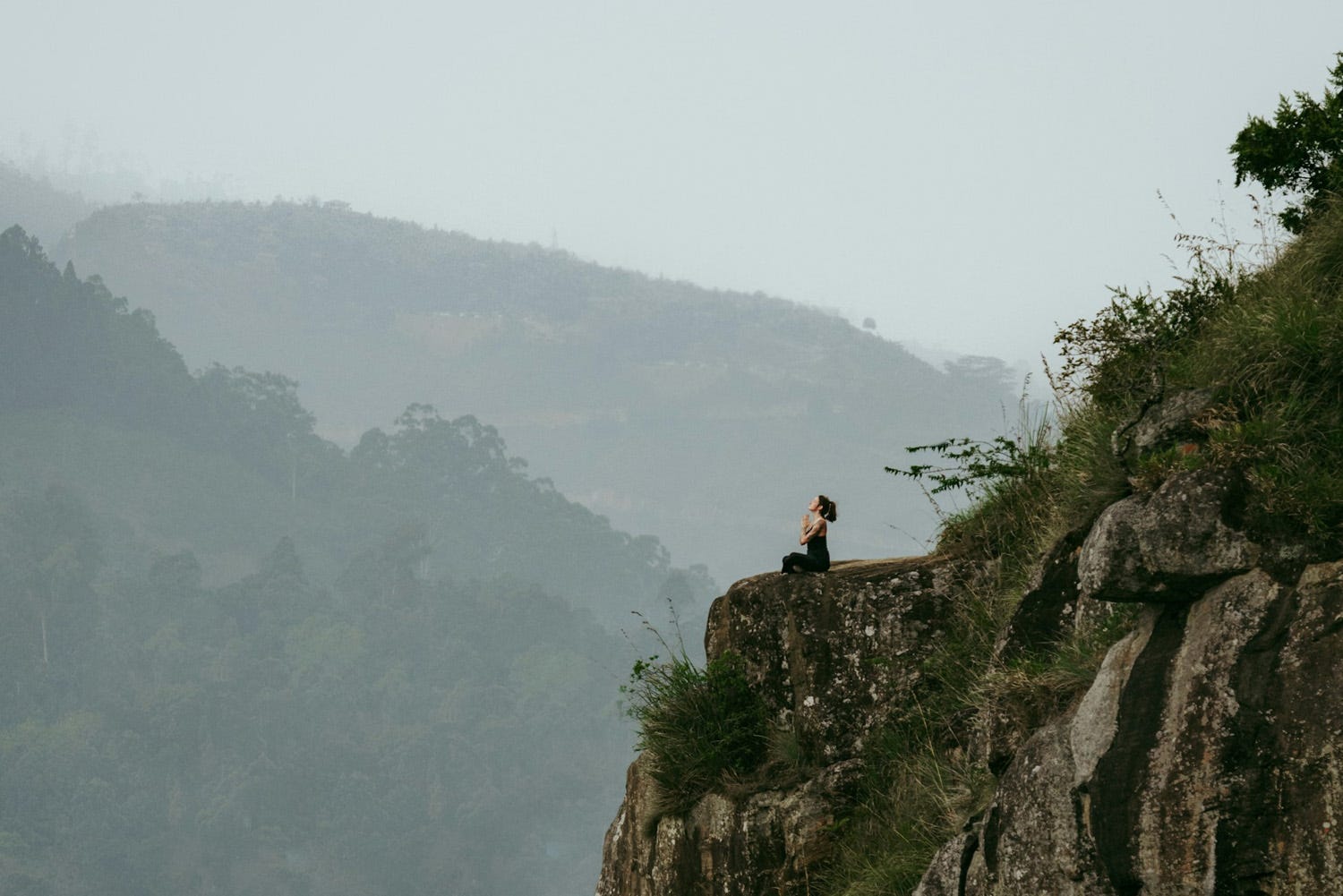
A personal journey
The question you might be asking is, what’s the difference, at the end of the day? What does it matter how we clear our minds, as long as we do?
The how matters because process and purpose are directly connected to context and outcome. If you’re trying to attain clarity of mind in a stressful, overstimulating, disconnected society by utilizing tools and methods that further emphasize individual disconnection, you’re only drilling deeper into the same cave you’re trying to climb out of. Trying to live in sacred time the Maya way, in a Western city like Los Angeles or Paris, works only to a degree because the dynamics and energy of an urban metropolis grate directly against the dynamics and energy of a Central American village.
Many meditation guides, especially those for beginners, ask you to clear the physical environment where you’re planning on doing your meditation practice. Find a room or space in your house where you won’t be disturbed; turn off your phone; sit in a comfortable upright position; wear something loose and comfortable. The focus is almost invariably as much on our external surroundings as it is on our internal mental space, and at times more on the former than the latter. It’s a nice luxury we do not always have. What is one meant to do, if we are not in a quiet place, aren’t wearing particularly comfortable clothes, or can’t sit quietly in a comfortable position? The implication here is, don’t meditate until you can secure that spot. Conversely, you can be in a sunlit hut at the top of a mountain on a clear day, dressed in flowing linen robes, sitting on a softly swinging patio chair, but if your mind is racing or you’re stressed because you just got laid off or you discovered your partner has not been truthful about something important to you, none of those external factors matter.
This is precisely what commodifies and productizes meditation. It’s disingenuous, to yourself, to meditate for 15 minutes a day and spend the rest of it in stress mode. You don’t take one deep breath and expect it to last you the rest of the day. If clarity and calm are as foundational as all the gurus say—and they are!—then we need to build them into the very foundation of our psyche. In truth, mental clarity should be accessible anytime, anywhere, and should not depend on the privilege of a noise-free space. But full, complete mental clarity doesn’t happen until you’ve got years of practice, until your mind has reached the state of fudoshin. It’s a catch-22: how do you attain an immovable mind, which you need to thrive in a chaotic 24x7 world, when the chaotic 24x7 world ruptures your every attempt at finding a quiet space? Who has the time and money to travel to a Zen monastery for a week?
If you don’t have a special space or time of day for meditation, don’t let that stop you. This whole thing about sitting cross-legged and breathing in undisrupted rhythm for an hour is a privilege that many of us simply don’t have. There is another way.
I’m a poet, a writer, a thinker. I need quiet or low-key music when I write; I’m less than thrilled when someone is tapping a pencil on a desk, talking loudly, or running a leaf blower outside. You would think I’d be the first person to wake up at 5am and meditate. Not to disappoint but... I’ve never woken up at 5am to meditate or exercise (except to run to the airport, and then it’s praying, not meditating). I have, however, done meditation, both guided and self-guided. Personally, as a working mom, I find trying to fit a formal meditation session into my day a little unrealistic. It’s not impossible, but as a writer and thinker, I have an innate dynamic that just so happens to be highly appropriate for meditation. If you’re a writer, poet, philosopher, or a creative type, you might already do this as well, and just need to harness it. I call it living in meditation.
I operate in a semi-meditative state throughout the day. That’s how most of my work here at The Muse is born. This very essay is the result of hours of meditation upon the subject of meditation, research, reading, and life experiences. My family calls me a daydreamer, which doesn’t quite encompass what goes on in my head. Daydreaming is what it looks like to them, because they’re not inside my mind. But daydreaming, defined as mind-wandering and a largely beneficial cognitive function in scientific circles, is in fact the opposite of meditation. A daydream state is simultaneously unfocused and closed, fluttering from one thought to another randomly, yet closed off to the wider world; a meditative state is highly focused while fully open and aware. This seems contradictory at first: how can you focus while being aware of the outside world? In Japan, some sensei (teachers) of the way of the samurai, talk about the “big view”—the ability to open your eyes and take in the entire world around you, rather than looking at a single thing such as a tree or a person. It’s conceptually similar to the de-focusing of your eyes that you need to do if you want to see those hidden 3D illustrations in stereograms (which, by the way, I absolutely love; I have a whole book of them). In other words, you defocus in order to open and focus, on a much deeper level.
If you have the time and the space for meditative practice, consider yourself blessed, and take advantage of it. But whether you do or not, try to attain mushin regardless: maintain a clear, calm mind throughout your day, even through routine stresses and conflicts. If you’re stuck in traffic, instead of letting frustration bubble up inside, let the anger pass, breathe through it. Notice all of the things you never do when you’re driving—the architecture of the buildings, people crossing, trees and flowers in backyards.5 If you’re in a meeting where people are talking over each other, take a step back and watch the dynamics without letting your ego take control. Long lines in the grocery store, your favorite restaurant or the cinema? Same approach.
Note I said “routine stresses and conflicts” — situations that place you in physical danger call for a different course of action, and typically require training.
One note on breathing, which many of you will already be familiar with: breathe deep and long, rather than shallow and short. Use your diaphragm, your belly, and make sure your exhale is longer than your inhale. This activates your parasympathetic nervous system, which calms down your body after an episode of stress or panic.
Over time, as you practice working, living, and being in this meditative state, it will become as natural as breathing. It is important that you incorporate it into your daily life, and make it as habitual as brushing your teeth, putting on your seatbelt when you drive, or paying the rent or mortgage on time every month. If you’re committing to these basic things, why not commit to a practice that will shift the way you experience your life and move through the world? Find the form of meditative practice that works for you. It can be sitting for a certain length of time in the early morning or just before bed. It can be a moving meditation, as part of a martial arts practice. If you prefer to join a local Zen center, that’s cool too. Whatever feels right, natural, and doable. If it feels forced, it is. Trust that instinct.
Closing bow
I hope you’ve enjoyed learning about the way of the warrior and the foundational states of mind the samurai embodied. If you’re wondering when we’re going to get to the “good stuff”—all the critical thinking techniques and practices you might be impatiently waiting for—I would offer this gentle reminder. A critical mind is like a katana sword, forged of layer upon layer of resilience and precision, through patient learning, practice, and deep insight unencumbered by emotion, judgment, or attachment. You are already on the path.
In our next session, we’ll explore the concept of freedom—of the mind. Mental freedom is an integral part of mental clarity. There is no clarity without freedom.
See you next time.
Gratitude, always
Deep bow to everyone who has supported my work, and warmest of welcomes to all the new readers! Whether you’re a paying subscriber or have bought me a coffee or two, know that your support is felt and appreciated.

[direct link here if the giphy thingie doesn’t work]
Thuc Nhi Nguyen, “Ilia Malinin describes crippling anxiety that cost the favorite a Winter Olympics medal,” Los Angeles Times (online), February 13, 2026, https://www.latimes.com/sports/olympics/story/2026-02-13/ilia-malinin-suffers-stunning-stumble-finishes-eighth-at-olympics. Accessed on February 13, 2026.
S.F.Radzikowski, “Mushin State of No Mind In Martial Arts,” Shinkan-ryū blog, November 30, 2018, https://shinkanryu.org/mushin-no-mind/. Accessed on March 12, 2026.
I kid, tho not as much as you’d think. It does take ongoing, fierce commitment and dedication to resist the daily onslaught.
CMI, “Meditation Market Poised for Explosive Growth, Projected to Hit USD 17.78 Billion by 2032 Says Coherent Market Insights,” Global Newswire, September 4, 2025, https://finance.yahoo.com/news/meditation-market-poised-explosive-growth-140000959.html. Accessed on February 13, 2026.
I realize you might be stuck in traffic on the freeway, in which case you’re not likely to be able to admire any of these things. If the freeway you’re stuck on doesn’t happen to be particularly beautiful, even better: this forces you to practice mushin straight up, no whipped cream on top.
Beautiful! Again!
Thanks so much Birgitte for this moment, for this document that we can, ideally, always come back to when needed.
Love the references to other cultures that have solved so many problems and that you share with us!
I just realized that I messed up one piece of software that I used to relax with and meditate since it brings me back to the time of my life when I needed it.
Oh well, I'll find other helpers.
Mushin. Such a fragile state. We handle so much unnatural stress in this artificial world that even when we're calm and focused we're on the edge. Trying to find my center right now. Buggy computer software grade destroying my inner calm. Somewhere a team of engineers did a shit job pressured by the bean counters, and now it's costing me time. Mouse cursor jumping, an essential device not being seen. I'm handling collapse fairly gracefully, but this is putting me on edge. The line between calm and crazy is incredibly thin.